

Why a Nighttime Routine Helps Sleep: Your Science Guide
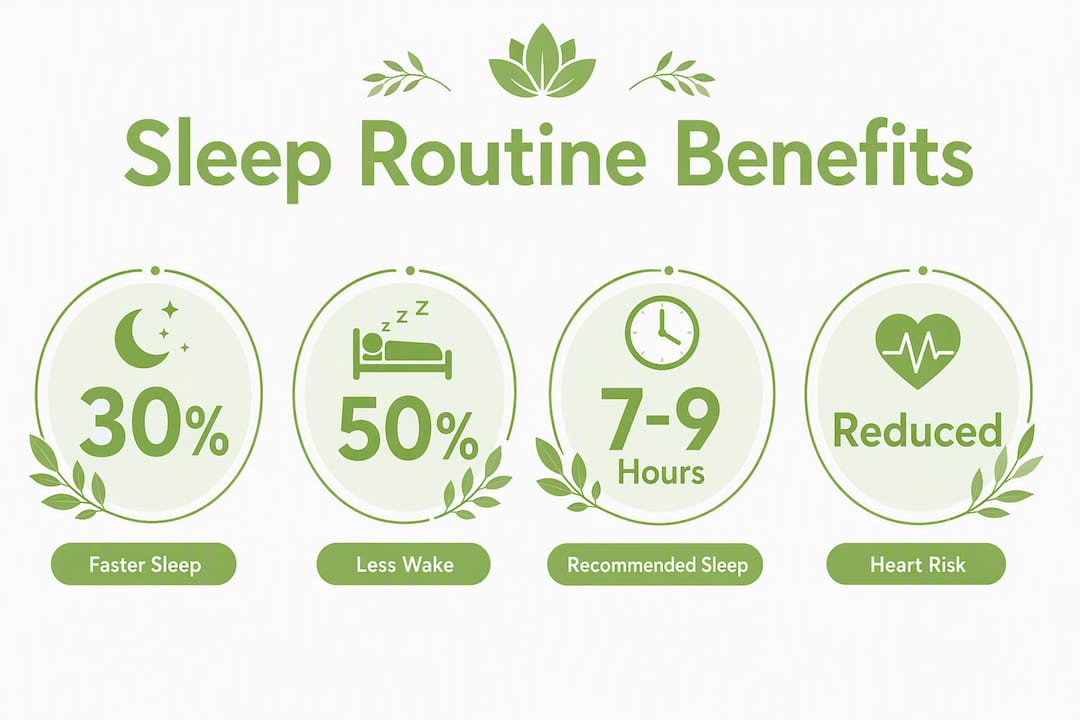
A consistent nighttime routine improves sleep by aligning your internal circadian clock and lowering the cognitive and physiological arousal that keeps you awake. That's the short answer. The American Heart Association recommends adults get 7–9 hours per night as part of its Life's Essential 8 framework, and the research is clear that when you sleep matters as much as how long.
Start tonight with these three steps:
- Set a fixed lights-out time and stick to it, including weekends. Consistency is the mechanism, not the duration.
- Begin a 30–60 minute wind-down before that time. Low-arousal activities only: reading, gentle stretching, or a warm shower.
- Remove screens 30–60 minutes before bed. Blue light suppresses melatonin secretion and delays sleep onset.
Table of Contents
- Why does a nighttime routine help sleep? The biology behind it
- What to include (and cut) in an effective nighttime routine
- How to build a simple personalized bedtime routine in 30–60 minutes
- Three ready-to-use bedtime routines you can start tonight
- What the research actually shows about sleep routines and health
- When a routine isn't working and when to see a clinician
- Key Takeaways
- The honest case for sticking with it
- Authoritative sources for further reading
Why does a nighttime routine help sleep? The biology behind it
Two systems govern when you fall asleep. The first is your circadian rhythm, a roughly 24-hour internal clock synchronized to light and darkness. The second is homeostatic sleep pressure, the biochemical drive that builds the longer you stay awake. Sleep happens most easily when both systems align, meaning your clock says "it's time" and your sleep pressure is high enough to carry you under quickly.
A consistent bedtime routine acts as an external anchor for the circadian clock. Cleveland Clinic guidance on circadian rhythm explains that regular bed and wake times strengthen the synchrony between your internal clock and the external light-dark cycle, reducing what researchers call "social jetlag," the misalignment that builds when your schedule shifts on weekends.
Routines work because they condition the nervous system, not just the schedule. Each repeated pre-sleep behavior becomes a cue that triggers physiological deactivation: heart rate drops, cortisol falls, and sympathetic nervous system activity quiets. That sequence shortens sleep latency and improves how consolidated your sleep feels across the night.
A PMC review on bedtime routines and sleep onset confirms that routines done in the hour before sleep reduce latency and facilitate this deactivation process. The key word is conditioned. Over time, the routine itself becomes the trigger, not just the clock.
Hyperarousal is the main enemy. A comprehensive PMC assessment of bedtime routines identifies the inability to deactivate as central to insomnia, and notes that pre-sleep routines are a core target behavior in Cognitive Behavioral Therapy for Insomnia (CBT-I). For many adults, hyperarousal is a persistent feature across the whole day, not just at bedtime. Predictable, low-arousal pre-sleep behaviors are the conditioning tool that gradually retrains the nervous system.

What to include (and cut) in an effective nighttime routine
The goal is a sequence of behaviors that reliably lower arousal. The specific activities matter less than their ability to reduce sympathetic activation night after night.
What to add
- Optimize the bedroom. Cool (around 65–68°F), dark, and quiet. These three environmental factors consistently appear in clinical guidance from the Harvard Division of Sleep Medicine.
What to cut
- Screens close to bedtime — Blue-wavelength light from phones and laptops suppresses melatonin and shifts the circadian clock later, making it harder to fall asleep at your target time.
Pro Tip: Pick 1–3 wind-down activities you can genuinely do every night. The criteria: low mental engagement, repeatable without effort, and mildly rewarding. A 10-minute read and a warm shower beats an elaborate 12-step ritual you'll abandon by Thursday.
How to build a simple personalized bedtime routine in 30–60 minutes
This is a practical sequence, not a prescription. Adjust it to your life.
- Pick your target wake time first. Work backwards from when you need to be up. If you need 8 hours and must wake at 6:30 AM, your lights-out time is 10:30 PM.
- Set your wind-down start time. Subtract 30–60 minutes from lights-out. That's when you put the phone down and shift gears.
- Choose 2–3 low-arousal activities. One physical cue (warm shower, light stretching), one mental cue (reading, journaling, breathing exercise), and one environmental cue (dim lights, lower thermostat). Three anchors are enough.
- Set environmental cues. Drop the thermostat to 65–68°F around 30 minutes before bed. Use blackout curtains or a sleep mask. If noise is an issue, a white noise machine or fan works well.
- Use a reminder alarm. Set a phone alert 60 minutes before lights-out labeled "wind-down starts." The irony of using your phone to limit phone use is real, but it works until the habit is automatic.
- Run a two-week test. Track four things each morning: bedtime, wake time, how long it took to fall asleep (estimated), and a 1–5 rating of how rested you feel. Two weeks gives you enough data to see a pattern.
Troubleshooting common barriers:
- Irregular work schedule: Anchor to your wake time, not your bedtime. A consistent morning alarm does more for circadian stability than a perfect bedtime.
- Caregiving or parenting: Micro-routines work. Even a 10-minute sequence (dim lights, one calming activity, consistent sleep cue) produces conditioning over time.
- Shift work: Use blackout curtains and a consistent sleep block relative to your shift, not the clock. Light exposure timing becomes your primary lever.
Three ready-to-use bedtime routines you can start tonight
Pick the one that fits your evening, then tweak it.
Short routine (15–20 minutes) for late nights
- Wash face, brush teeth (habit anchor)
- 5 minutes of slow breathing or a brief body scan
- Dim all lights, set thermostat
- One page or one chapter of a physical book
- Lights out at fixed time
The goal here is a single strong anchoring cue, not a full wind-down. Consistency matters more than length.
Moderate routine (30–45 minutes)
- Warm shower or bath (10 minutes)
- Light snack if genuinely hungry (something small and low-sugar)
- 15 minutes of reading or a guided breathing app like Calm or Headspace
- Dim lights and device curfew 30 minutes before lights-out
- Lights out at fixed time
This is the most practical template for most adults. The shower provides a physical transition; the reading replaces screen time without requiring willpower.
Full routine (45–60+ minutes)
- Warm bath (15 minutes)
- Brief journaling: 3 things that went well, one task to release until tomorrow
- 10 minutes of gentle yoga or progressive muscle relaxation
- Guided meditation or slow breathing (5–10 minutes)
- Lights out at fixed time
Journaling is worth calling out specifically. Writing down tomorrow's tasks before bed reduces the "open loops" that keep the prefrontal cortex active, which is one reason it shortens sleep latency for people with high pre-sleep worry.
Tailoring notes
- Evening chronotypes ("night owls"): — Your natural sleep pressure peaks later. Don't fight it with an artificially early bedtime. Shift your entire routine 60–90 minutes later and use morning light exposure to gradually move your clock earlier if needed.
What the research actually shows about sleep routines and health
The benefits of consistent sleep habits extend well beyond feeling less groggy.

A large-scale UK Biobank analysis found that integrating sufficient sleep duration into a consistent routine was associated with an estimated a notable estimated reduction in population incidence of future mental disorders across more than 100,000 participants. That's a population-level effect from behavioral consistency, not medication.
On the mortality side, a prospective UK Biobank cohort study published in eLife found that sleep regularity predicted mortality risk independently of total sleep duration. People with the most irregular sleep timing had higher mortality rates. The implication: how consistent your schedule is may matter as much as how many hours you log.
At the individual level, a PMC intervention study found that implementing a consistent bedtime routine produced measurable improvements within the first 3 nights, with clinically meaningful changes over two weeks. Sleep onset latency decreased by more than 6 minutes and the longest consolidated sleep block increased by more than 1 hour in that study's population.
| Outcome | Finding | Source |
|---|---|---|
| Recommended nightly sleep | 7–9 hours for adults | American Heart Association |
| Mental disorder risk reduction | ~23% estimated population reduction with consistent routine + sufficient duration | UK Biobank (Springer) |
| Sleep onset latency improvement | Decreased measurably over two weeks | PMC6587179 |
| Consolidated sleep increase | Longest sleep block increased significantly over two weeks | PMC6587179 |
| Mortality risk | Sleep regularity predicts longevity independently of duration | eLife / UK Biobank |
The cardiovascular angle is worth noting separately. The American Heart Association classifies sleep as one of Life's Essential 8, placing it alongside diet, exercise, and blood pressure as a pillar of heart health. A routine that reliably delivers 7–9 hours of quality sleep is, by that framing, a preventive cardiovascular behavior.
When a routine isn't working and when to see a clinician
Most routines take 2–4 weeks to produce consistent results. If yours isn't working after that window, the issue is usually one of four things:
- High pre-sleep arousal that the routine isn't touching — Add a structured worry-dump journal entry before your wind-down, or try progressive muscle relaxation. If anxiety is the driver, a therapist trained in CBT-I can address the cognitive component directly.
Red flags that warrant a clinician visit:
A primary care physician can screen for sleep apnea and refer you to a sleep specialist. CBT-I, delivered by a trained therapist or through digital programs like Sleepio, is the first-line treatment for chronic insomnia and is more effective long-term than sleep medication for most adults.
Key Takeaways
A consistent nighttime routine improves sleep by conditioning the nervous system to deactivate on cue, anchoring your circadian clock, and reducing the arousal that delays sleep onset.
| Point | Details |
|---|---|
| Start with wake time | Fix your morning alarm first; a consistent wake time anchors the circadian clock more reliably than bedtime alone. |
| 30–60 minute wind-down | Begin low-arousal activities 30–60 minutes before lights-out to trigger conditioned deactivation. |
| Screen curfew matters | Remove screens 30–60 minutes before bed; blue light suppresses melatonin and delays sleep onset. |
| Results come quickly | Measurable improvements in sleep onset and consolidation can appear within the first 3 nights of a consistent routine. |
| Long-term health stakes | Sleep regularity predicts mortality risk independently of duration; consistent routines are a preventive health behavior, not optional comfort. |
The honest case for sticking with it
Most people expect a new sleep routine to feel transformative by night three. Sometimes it does. More often, the first week feels about the same, the second week is noticeably better, and the real payoff shows up a month in when you realize you haven't stared at the ceiling in weeks.
The research on timelines is actually encouraging. Measurable gains in sleep onset and consolidation can appear within a few nights of consistent routine implementation. But the deeper benefits, the cardiovascular protection, the mental health effects, the reduction in daytime fatigue, those accumulate over months, not days. Expecting overnight transformation is the fastest way to abandon a routine that's actually working.
Setbacks are normal. A late Saturday night, a work trip, a sick child at 2 AM. None of that erases your progress. The practical fix is simple: hold your wake time the next morning, get morning light exposure, and re-anchor that evening. One disrupted night doesn't reset a conditioned nervous system.
If you're exploring optional support alongside behavioral changes, Kingbuddha offers lab-tested, U.S.-sourced CBD sleep support gummies and CBD tinctures formulated for nighttime use. They're not a substitute for a consistent routine, but for adults who want to pair a behavioral wind-down with a hemp-derived supplement, they're a vetted option. Kingbuddha also publishes a practical guide on building a bedtime CBD routine for anyone who wants to think through the integration carefully.
The bottom line: the routine is the intervention. Everything else is support.
Authoritative sources for further reading
These are the primary clinical and research sources behind this guide. Each goes deeper than a single article can.
- Harvard Division of Sleep Medicine: Adopt Good Sleep Habits — Clinical guidance on sleep hygiene, circadian timing, and behavioral strategies from one of the leading academic sleep programs in the U.S.
- PMC: Bedtime Routines and Sleep Onset Mechanisms (PMC11221196) — Reviews the evidence for how pre-sleep routines reduce latency and facilitate physiological deactivation.
This article is general health information, not medical advice. If you have persistent sleep problems or suspect a sleep disorder, consult a qualified healthcare professional or sleep specialist.