

Contaminant Testing for CBD Buyers: What It Means
Contaminant testing screens hemp and CBD products for harmful substances introduced during cultivation, extraction, or manufacturing. The single most important thing you can do before buying: pull up the product's third-party COA and confirm it shows "PASS" for the four main contaminant panels. A 2024 peer-reviewed study of 202 commercial CBD products found heavy metals in 44 products and residual solvents in 181 of them, with several results exceeding regulatory thresholds. That's not a fringe problem.
Table of Contents
- What does contaminant testing actually cover?
- How do labs actually run these tests?
- How to read a COA before you buy
- When testing happens and what it costs
- Trust signals and red flags on a COA
- A buyer checklist for choosing safer CBD products
- Kingbuddha: how we test and where to find our COAs
- Key Takeaways
- Why testing transparency is the only honest position
- Lab-tested CBD from Kingbuddha, ready to shop
- Useful sources and regulators to check
What does contaminant testing actually cover?
The industry shorthand is the "big four," and every COA worth trusting should address all of them.
- Pesticides: Herbicides and insecticides used during cultivation can concentrate in the final extract. Organophosphates and pyrethroids are common targets.
- Heavy metals: Lead, arsenic, cadmium, and mercury are the standard panel. Hemp is a bioaccumulator, meaning it pulls metals from soil readily, which is why heavy metal detection matters even for products from reputable farms.
- Residual solvents: Ethanol, butane, hexane, and propane are used in extraction. Vape products and concentrates carry the highest risk here because solvent-based processes are common in those formats.
- Microbial impurities: Mold, yeast, E. coli, Salmonella, and Aspergillus species. Ingestibles and flower products are the highest-risk formats for microbial contamination.
Beyond the big four, a thorough COA may also cover mycotoxins (mold-produced toxins), terpene profiles, foreign matter, moisture content, water activity, and phthalates. Oregon's post-harvest hemp testing requirements and New York's Cannabis Control Board both mandate microbiological contaminants, mycotoxins, pesticides, residual solvents, and heavy metals for finished products, which gives you a useful benchmark for what a complete panel looks like regardless of which state you're shopping in.
Pro Tip: If you're buying a vape or concentrate, check that the COA explicitly includes residual solvent results. A COA that only covers potency and heavy metals is not sufficient for those formats.
How do labs actually run these tests?
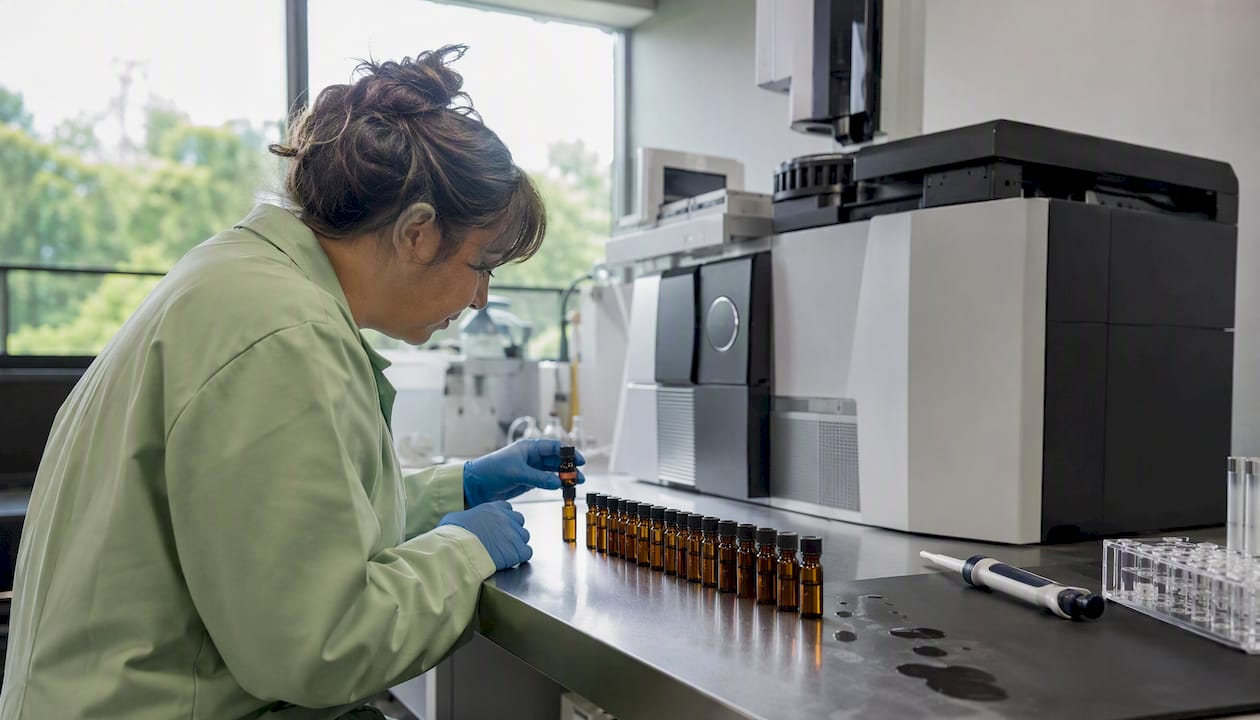
Labs don't use one method for everything. Each contaminant class requires a different analytical approach, and knowing which method produced a result tells you something about its reliability.
| COA Field | What It Tells You |
|---|---|
| Batch / Lot ID | Ties the test to a specific production run — must match your package |
| Test Date | Confirms results are current and not recycled from a prior batch |
| Analyte Name | The specific substance tested (e.g., Lead, Aflatoxin B1, Hexane) |
| Detected Value + Units | The measured concentration (e.g., μg/g, ppm, CFU/g) |
| LOD / LOQ | Limit of Detection / Limit of Quantitation — the lowest amount the method can reliably find |
| PASS / FAIL | Whether the detected value falls within the allowed regulatory limit |
| Lab Accreditation Stamp | Confirms the lab meets ISO/IEC 17025 or a state-equivalent standard |

Labs commonly use GC-MS and LC-MS for pesticides and residual solvents, ICP-MS for heavy metals, and qPCR for microbial detection. GC-MS (gas chromatography-mass spectrometry) is particularly well-suited to volatile compounds like solvents. ICP-MS (inductively coupled plasma-mass spectrometry) can detect metals at parts-per-billion concentrations. Samples are batch-specific, meaning a lab pulls from a defined production lot, not a random shelf unit.
How to read a COA before you buy
Reading a COA takes about two minutes once you know what to look for. Work through it in this order:
- Match the batch number. The lot or batch ID on the COA must match the number printed on your product label or packaging. A COA without a matching batch ID cannot verify the safety of the item in your hand.
- Check the test date. A COA from two or three years ago is not reliable for a product manufactured recently. Look for a test date that aligns with the product's production window.
- Confirm the lab is third-party. The lab name on the COA should not be the same as the brand selling the product. An in-house test is not independent verification.
- Read the PASS/FAIL column for all four panels. The New Jersey Cannabis Regulatory Commission's COA guidance explicitly recommends consumers check that status fields read "PASS" for heavy metals, pesticides, and microbial contaminants.
- Look at LOD and LOQ. A result listed as "non-detect" is only meaningful if the COA also shows the LOD or LOQ. Without those numbers, you can't know whether the method was sensitive enough to catch low-level contamination.
- Verify lab accreditation. ISO/IEC 17025 accreditation is the gold standard. Some states require their own equivalent (Oregon uses ORELAP-accredited labs). The accreditation number or certificate should appear on the report.
- Confirm the product matrix. A COA run on a tincture does not cover a gummy from the same brand. The matrix listed on the COA should match the product format you're buying.
Pro Tip: Scan the QR code on the product packaging. It should link directly to a third-party lab file, not a branded PDF. Confirm the batch ID in that file matches what's on the package.
When testing happens and what it costs
Testing is batch-based. After extraction or formulation, a sample from that specific production run goes to the lab before the product ships. Retesting can happen after a reformulation, a consumer complaint, or a regulatory audit.
Turnaround time from sample submission to COA delivery typically runs 3–14 business days, depending on the panels ordered and the lab's current throughput. Full panels covering all four contaminant categories take longer than a basic potency-only run.
The brand or processor pays for testing, not the consumer. Basic panels cost less than comprehensive ones, and pricing varies by region, lab, and test complexity. What this means for you as a buyer: a brand that skips full-panel testing is cutting a real cost, and that cost-cutting shows up as missing data on the COA. Regulated markets, including states with formal hemp programs, often mandate testing frequency and minimum panels. Unregulated markets are more variable, which is exactly why understanding contaminant testing matters before you shop.
Trust signals and red flags on a COA
Because federal standardization for hemp is limited, ISO/IEC 17025 accreditation and visible third-party COAs are the most reliable signals a consumer can use. Here's what to look for and what to avoid:
Trust signals:
- Lab name is independent of the brand, with a visible accreditation number
- ISO/IEC 17025 or state-equivalent accreditation confirmed
- Batch ID on the COA matches the product packaging
- PASS results for all four major panels
- LOD and LOQ values listed for each analyte
- COA is accessible via a direct URL or QR code, not a downloadable brand PDF
Red flags:
- Missing batch ID or a generic product-level COA
- "Non-detect" results with no LOD or LOQ listed
- COA formatted like a marketing brochure rather than a lab report
- No lab accreditation information anywhere on the document
- Test date predates the product's manufacturing date
- Only potency tested, with no contaminant panels
Clinical research confirms that regulated products with independent testing and clear labeling carry meaningfully lower contamination risk than unregulated alternatives.
A buyer checklist for choosing safer CBD products
Use this before completing any purchase:
- Is a COA available and viewable without contacting the brand?
- Does the batch number on the COA match the product label?
- Is the test date recent and consistent with the product's manufacturing window?
- Does the COA show PASS for heavy metals, pesticides, residual solvents, and microbial impurities?
- Is the lab ISO/IEC 17025 accredited or state-certified?
- Does the COA cover the correct product format (gummy, tincture, vape, topical)?
- Are LOD and LOQ values listed for contaminant analytes?
- Does the brand publish COAs for every batch, not just one representative test?
If you're buying for someone in a vulnerable group, including pregnant individuals, immunocompromised people, or children, prioritize products with full-panel COAs and confirmed PASS results for microbial impurities and mycotoxins specifically. Those contaminants carry the highest acute health risk for people with compromised immune function. You can also ask customer service directly: "Can you send me the COA for the specific batch I'm ordering?" A brand that can't answer that question quickly is a brand worth skipping. For a deeper look at finding lab-tested CBD, Kingbuddha's safety guide walks through the process step by step.
Kingbuddha: how we test and where to find our COAs
Kingbuddha submits products across its full line, including CBD gummies, tinctures, topicals, and hemp flower, to third-party labs for batch-specific contaminant testing. Every production run gets its own COA covering the main contaminant panels, and those reports are posted publicly. You can access them directly at the lab reports page or by scanning the QR code on any Kingbuddha product. Kingbuddha prioritizes ISO/IEC 17025-accredited labs and publishes PASS results for heavy metals, pesticides, residual solvents, and microbial impurities. If you have questions about a specific batch or want to review a COA before purchasing, the customer support team can point you to the right report.
Key Takeaways
Contaminant testing is the single most reliable way to verify that a CBD or hemp product is free from pesticides, heavy metals, residual solvents, and microbial impurities before you buy it.
| Point | Details |
|---|---|
| The big four contaminants | Every COA should cover pesticides, heavy metals, residual solvents, and microbial impurities. |
| Batch ID is non-negotiable | A COA without a batch number matching your product cannot verify that specific item’s safety. |
| LOD / LOQ matters | “Non-detect” results are only meaningful when the COA lists the detection and quantitation limits. |
| ISO/IEC 17025 accreditation | Lab accreditation is the clearest signal that test results are reliable and independently verified. |
| Kingbuddha’s COA access | Kingbuddha publishes batch-specific COAs at its lab reports page and via product QR codes. |
Why testing transparency is the only honest position
The conventional wisdom says "just buy from a reputable brand." That's not wrong, but it's incomplete. Reputation is a lagging indicator. A brand can have a good track record and still ship a contaminated batch if its testing is inconsistent or its COAs aren't batch-specific. The Frontiers 2024 study found residual solvents in 181 of 202 tested products. That's not a niche failure mode. It's a systemic one.
What actually protects you is the COA itself, specifically a batch-matched, third-party COA from an ISO/IEC 17025-accredited lab with PASS results for all four panels. Everything else, brand story, packaging, price point, is secondary. The brands worth trusting are the ones that make this verification easy, not the ones that make you ask for it.
Lab-tested CBD from Kingbuddha, ready to shop
Kingbuddha makes the verification step simple. Every product comes with a batch-specific COA from a third-party, accredited lab, and every COA is publicly accessible before you buy.
The full product line covers CBD sleep gummies, CBD tinctures, topicals, and hemp flower, all tested for the contaminant panels this article covers. Each product page links directly to its COA, so you can check PASS status, batch ID, and lab accreditation before checkout. Visit the lab reports page to browse COAs by product, or scan the QR code on any Kingbuddha package to pull the report for your exact batch.
Useful sources and regulators to check
- New Jersey Cannabis Regulatory Commission COA Guide: Practical field-by-field COA interpretation that applies nationwide, not just in New Jersey.
- PMC Clinical Framework for Cannabis Product Quality: A peer-reviewed clinical framework explaining why independent testing and regulated products carry lower contamination risk.
- Frontiers in Pharmacology 2024 Contamination Study: Peer-reviewed analysis of 202 commercial CBD products documenting contamination prevalence and label inaccuracy.
- Oregon Department of Agriculture Post-Harvest Hemp Testing Requirements: State-level testing mandates that show what a complete panel looks like for hemp concentrates and finished products.
- New York Office of Cannabis Management Testing Limits: Comprehensive analyte list and regulatory limits for adult-use and medical cannabis products in New York.
- Iowa HHS Trace Amounts Guidance for Consumable Hemp: State-level acceptance criteria for toxicants in consumable hemp products, including metals, solvents, and pesticides.
- Kingbuddha Compliance and CBD Guide: Explains how compliance requirements shape independent testing practices in the hemp industry.
This article is general educational information, not medical or legal advice. Verify current testing requirements with your state's cannabis or agriculture regulator, and consult a qualified professional for guidance specific to your situation.