

Why Transparency Matters with CBD: A Safety Guide
TL;DR:
- CBD product transparency involves openly disclosing cannabinoid content, contaminant testing results, and sourcing information for consumer safety. Many products have labeling inaccuracies and
- undisclosed contaminants, highlighting the importance of verified batch-specific Certificates of Analysis from accredited laboratories. Ensuring transparent testing reduces risks of dosing errors and exposure to harmful substances, fostering safer CBD consumption.
Transparency in CBD products is defined as the open disclosure of cannabinoid content, contaminant testing results, and sourcing information so consumers can make safe, informed purchasing decisions. The CBD market has expanded rapidly, and with that growth comes a serious problem: not every product on the shelf is what its label claims. Understanding why transparency matters with CBD is not a preference. It is a safety requirement. Research from the Journal of Cannabis Research and PLOS One confirms that labeling inaccuracies and undisclosed contaminants are measurable, documented problems affecting commercial CBD products sold today.
Why transparency matters with CBD product labeling
Accurate labeling is the foundation of CBD transparency, and recent research proves the gap between what labels claim and what products actually contain is significant. A 2026 study published in the Journal of Cannabis Research found that commercial CBD oils and e-liquids show consistent labeling inconsistencies, including both over-labeling and under-labeling of CBD concentrations, as well as the presence of undisclosed Δ9-THC. That finding means a product marketed as THC-free may not be, and a product claiming 1,000 mg of CBD may deliver significantly more or less.
THC concentration labeling varies by as much as ±15% across cannabis products, including flower, edibles, and concentrates. That margin is not trivial. For a consumer using CBD to manage anxiety or sleep, an unexpected THC dose can produce unwanted psychoactive effects. For a professional subject to drug testing, an undisclosed THC level can have serious consequences.
The contrast between legal and illicit products adds another layer of concern. Licensed cannabis products have been found to deviate over 20% from their labeled THC values, which shows that even regulated markets are not immune to labeling failures. Illicit products perform worse across nearly every safety metric, but the point stands: a label alone is not proof of accuracy.
| Label Claim | What It Should Mean | Common Failure |
|---|---|---|
| "1000 mg CBD" | Verified cannabinoid content per batch | Over or under-labeling by measurable margin |
| "THC-Free" | Non-detectable Δ9-THC | Undisclosed THC present in tested samples |
| "Third-Party Tested" | Independent lab verified this batch | Generic claim with no batch-specific COA |
| "Full Spectrum" | Complete cannabinoid profile disclosed | Incomplete or missing cannabinoid breakdown |
Pro Tip: Before buying any CBD product, look for the exact milligram count per serving, not just the total bottle content. A bottle labeled "1000 mg" with 30 servings should clearly state 33 mg per serving. If it does not, that is a transparency red flag.
How does third-party lab testing build trust in CBD brands?
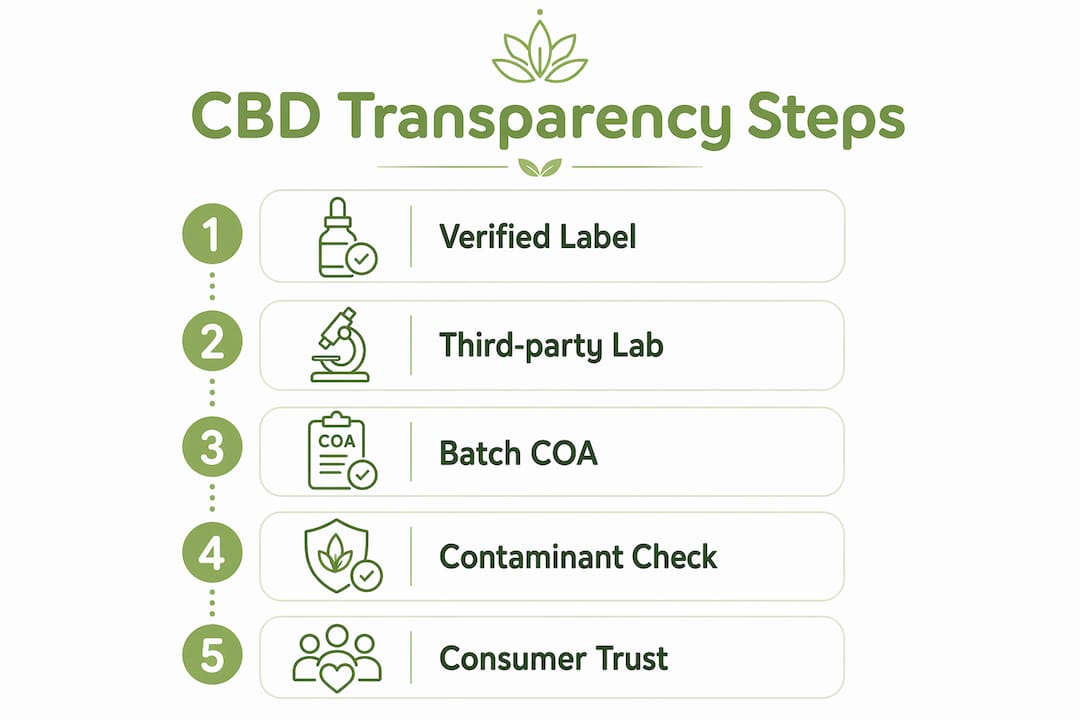
Third-party lab testing is the mechanism that makes CBD transparency verifiable rather than theoretical. A Certificate of Analysis, commonly called a COA, is the document that records those test results. Not all COAs are created equal, and knowing the difference protects you from misleading marketing.
The gold standard for lab accreditation is ISO/IEC 17025 certification, which confirms that a laboratory operates with validated methods, calibrated equipment, and audited quality controls. ACS Laboratory is one example of an accredited facility that meets this standard. When a COA comes from an ISO/IEC 17025-accredited lab, the results carry measurable credibility. When it does not, there is no independent verification that the testing methods are sound.
Batch-specific COAs are the other critical factor. Generic "third-party tested" claims often mislead consumers because the tested batch may not match the product in your hand. A COA is only meaningful when the batch number on the document matches the batch number on your product. Mismatched batches break the chain of trust and can indicate quality control failures that the brand has not disclosed.
Here is what a trustworthy COA includes:
- The name and ISO/IEC 17025 accreditation number of the testing laboratory
- A batch or lot number that matches the product packaging
- A complete cannabinoid profile, including CBD, THC, CBG, and CBN concentrations
- Test date within the last 12 months for the specific batch
- Results for contaminant panels relevant to the product format
- Pass or fail designations for each tested category
Pro Tip: Scan the QR code or visit the brand's lab report page directly rather than trusting a COA image embedded on a product page. Images can be altered. A live link to a third-party lab's portal cannot.
Kingbuddha publishes its batch-specific lab reports directly on its website, giving you access to the actual test data rather than a summary claim.
What contaminant testing reveals about CBD product safety
Cannabinoid potency is only one dimension of CBD transparency. Contaminant disclosure is equally important, and it is the area where many brands fall short. Pesticides, heavy metals, residual solvents, microbial organisms, and mycotoxins can all appear in hemp-derived products if the source material or extraction process is not properly controlled.
The data on illicit versus licensed products is striking. Research found that 94% of illicit cannabis samples contained pesticide residues, averaging 3.4 active pesticide ingredients per sample. Even among licensed products, 20% exceeded microbial limits. This means contamination is not a fringe concern. It is a documented risk that transparent testing directly addresses.
The specific contaminants tested should match the product format:
- Vape products and e-liquids require residual solvent analysis because extraction processes use solvents that must be removed before the product is safe to inhale.
- Edibles and gummies require food safety panels covering heavy metals, mycotoxins, and microbial counts, since these products are ingested and processed through the digestive system.
- Tinctures and oils need both solvent and heavy metal panels, particularly for lead, arsenic, cadmium, and mercury, which can accumulate in hemp plants grown in contaminated soil.
- Topicals require microbial testing to confirm the product will not introduce harmful bacteria through skin contact.
Regulatory testing panels vary by product format, which means a COA for a vape cartridge should look different from a COA for a gummy. A brand that provides one generic COA for all product types is not meeting the transparency standard that product safety demands.
Consumers who understand contaminant testing transparency reduce their exposure to dosing errors and harmful substances. That is not a marketing claim. It is the direct, measurable benefit of demanding full disclosure from the brands you buy from.
How to evaluate CBD transparency before you buy
Knowing what transparency looks like in theory is useful. Knowing how to verify it in 60 seconds before a purchase is what actually protects you. The following steps give you a practical framework for assessing any CBD brand.
- Locate the COA before purchasing. A transparent brand makes its lab reports publicly accessible, not available only upon request. If you cannot find a COA on the brand's website or product page, treat that as a disqualifying factor.
- Match the batch number. Verify the COA batch number against the number printed on your product. A mismatch means the test results do not apply to what you are holding.
- Confirm lab accreditation. Search the lab name listed on the COA and verify its ISO/IEC 17025 status. Accreditation databases are publicly searchable. An unaccredited lab's results carry no independent verification.
- Check the test date. COAs older than 12 months may not reflect the current batch. Hemp products degrade over time, and cannabinoid concentrations can shift. A current test date confirms the results are relevant.
- Review the full contaminant panel. A COA that only shows cannabinoid potency is incomplete. Look for pesticide, heavy metal, microbial, and solvent sections appropriate to the product type you are buying.
- Watch for warning signs. Vague claims like "lab tested" with no linked document, COAs with no lab name or accreditation number, and products with no batch identifier on the packaging are all signals that a brand's transparency does not hold up to scrutiny.
Consumers who rely on accurate cannabinoid and contaminant information make better dosing decisions and reduce their risk of adverse reactions. That outcome depends entirely on brands providing the information in the first place.
Key takeaways
CBD transparency requires verified labeling, batch-specific COAs from ISO/IEC 17025-accredited labs, and full contaminant panels matched to the product format.
| Point | Details |
|---|---|
| Label accuracy is not guaranteed | Studies confirm over and under-labeling of CBD and undisclosed THC in commercial products. |
| Batch-specific COAs are non-negotiable | A COA must match your product's batch number to be meaningful. |
| Lab accreditation matters | Only ISO/IEC 17025-accredited labs provide independently verified test results. |
| Contaminant panels vary by product type | Vapes need solvent testing; edibles need food safety panels; tinctures need heavy metal analysis. |
| Transparency protects your health | Full disclosure of potency and contaminants directly reduces dosing errors and contamination risk. |
The transparency gap most CBD buyers never notice
I have spent years reviewing CBD products, and the single most common transparency failure is not outright fraud. It is the gap between what a brand implies and what it actually proves. A brand can say "third-party tested" and technically be telling the truth while showing you a COA from two years ago, from a non-accredited lab, for a batch that no longer exists. That is not transparency. It is the appearance of transparency, and it is far more common than most buyers realize.
The 2026 research from the Journal of Cannabis Research confirmed what I had observed anecdotally: the problem is not limited to sketchy brands operating in gray markets. Labeling inaccuracies show up in commercial products sold through legitimate channels. That finding should shift how you approach every CBD purchase, regardless of where you buy it.
What I find genuinely encouraging is that accreditation standards like ISO/IEC 17025 give consumers a concrete, verifiable benchmark. You do not need a chemistry degree to confirm a lab's accreditation status. You need five minutes and a search engine. The brands that make that verification easy are the ones worth trusting. The ones that make it difficult are telling you something important about their priorities.
The future of CBD transparency will be shaped by regulatory pressure and consumer demand in equal measure. Brands that build their reputation on verifiable documentation now will be the ones still standing when standards tighten. As a buyer, your purchasing decisions are the most direct signal you can send to the market.
— Juiced
Explore Kingbuddha's transparent CBD products
Kingbuddha builds every product around the transparency standard this article describes. Every formulation is backed by batch-specific COAs from accredited labs, with full cannabinoid profiles and contaminant panels available for review before you buy.
If you are looking for a starting point, the CBD Sleep Support Gummies come with accessible lab documentation that shows exactly what is in each gummy, including potency verification and safety panel results. For consumers who want to review the full scope of Kingbuddha's testing documentation, the lab report library is publicly available on the site. Transparency is not a feature at Kingbuddha. It is the baseline.
FAQ
What does CBD transparency actually mean?
CBD transparency means a brand openly discloses cannabinoid potency, contaminant testing results, and sourcing information through publicly accessible, batch-specific Certificates of Analysis from accredited laboratories.
Why is a batch-specific COA more important than a general lab test?
A batch-specific COA confirms that the exact product you purchased was tested, not just a representative sample from a different production run. Mismatched batches mean the test results do not apply to your product.
How do I know if a CBD lab is accredited?
Look for ISO/IEC 17025 accreditation listed on the COA and verify it through the lab's accreditation body. ACS Laboratory is one example of a facility that holds this certification and publishes its scope publicly.
Can a licensed CBD product still contain contaminants?
Yes. Research found that 20% of licensed cannabis products exceeded microbial limits, confirming that legal status does not guarantee safety. Full contaminant panel testing and disclosure are the only reliable safeguards.
What should I do if a brand cannot provide a COA?
Do not purchase the product. A brand that cannot provide a current, batch-specific COA from an accredited lab has not met the minimum standard for CBD transparency, regardless of its marketing claims.