

What Is Food Grade CBD Standard? A 2026 Guide
TL;DR:
- Food grade CBD is a regulatory designation that requires products to meet specific purity, contaminant testing, and daily intake standards. It is not a marketing label but a formal approval based on safety assessments conducted by authorities like the UK FSA or EFSA. Consumers should verify batch-specific testing results and ensure total daily intake does not exceed 10 mg of CBD from all sources.
Food grade CBD standard refers to CBD ingredients formally assessed and authorized by regulatory bodies for safe use in food products, defined by purity thresholds, contaminant limits, and maximum daily intake levels. The term "food grade" is not a marketing label you can self-apply. It is a regulatory designation tied to specific safety assessments conducted by agencies like the UK Food Standards Agency (FSA), Food Standards Scotland (FSS), and the European Food Safety Authority (EFSA). Understanding what is food grade CBD standard matters because it tells you exactly what purity, testing, and dosage requirements a product must meet before it qualifies as food safe.
What is food grade CBD standard and how is it defined?
Food grade CBD is defined as a novel food ingredient requiring a formal safety assessment before it can legally appear in food or food supplements. The FSA and FSS define food grade CBD isolate as a product with a purity of at least 98% CBD. That purity threshold is not arbitrary. It reflects the level at which regulators can reliably predict safety outcomes and set meaningful intake limits.
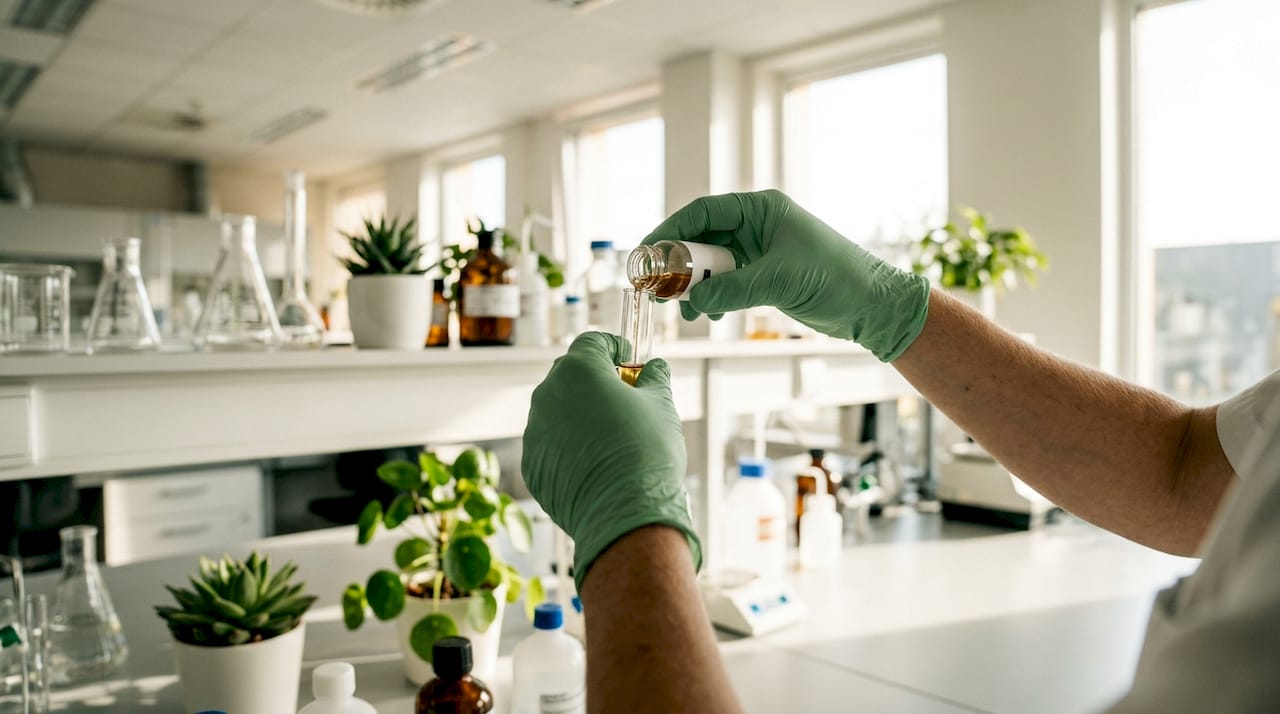
The provisional acceptable daily intake (ADI) tied to this standard is 10 mg of CBD per day for adults consuming products that meet the ≥98% purity specification. This figure is the safety ceiling regulators use when authorizing CBD isolate for food supplements. Exceeding it does not automatically cause harm, but it places a product outside the authorized safety window.
EFSA's 2025 scientific opinion on synthetic CBD goes further. It describes a purity level of ≥99.5% and a maximum intake of 30 mg per day for food supplement authorization. That higher threshold reflects the tighter control possible with synthetically produced CBD. The gap between 98% and 99.5% may sound small, but it represents a meaningful difference in contaminant load at scale.
What purity and contaminant controls define food grade CBD?
Purity is the foundation of food grade CBD quality standards, but contaminant control is where most products fail. Regulators require batch testing to confirm that Δ9-THC and other cannabinoids are present at levels below established safety thresholds. The FSA's assessments confirm that Δ9-THC must be undetected or below EFSA's acute reference dose at the 10 mg/day CBD use level.
Here is what food grade CBD contaminant and purity controls typically require:
- CBD purity: At least 98% CBD isolate by mass, with some regulatory frameworks requiring ≥99% or ≥99.5% for specific product categories.
- Δ9-THC limits: Batch testing must confirm THC is not detected or falls below the EFSA acute reference dose at the authorized intake level.
- Other cannabinoids: Residual cannabinoids beyond CBD are treated as contaminants and must be controlled within defined release specifications.
- Solvent residues: Third-party certification programs like NSF's dietary supplement standards include testing for solvents alongside THC, though these are product certifications rather than regulatory food grade definitions.
- Certificates of Analysis (COAs): Every batch must have a COA from a validated laboratory confirming it meets release specifications before it enters the supply chain.
The distinction between a third-party certification and a regulatory food grade authorization matters. NSF certification confirms a product passed specific contaminant tests. Regulatory authorization confirms the ingredient itself has been assessed for safety at defined intake levels. Both are valuable, but they are not the same thing.
Pro Tip: When reviewing a COA, check that the testing lab used validated analytical methods such as HPTLC or HPLC. A COA from an unaccredited lab carries no regulatory weight, regardless of what the results say.
How do regulatory agencies assess and authorize CBD as a novel food?
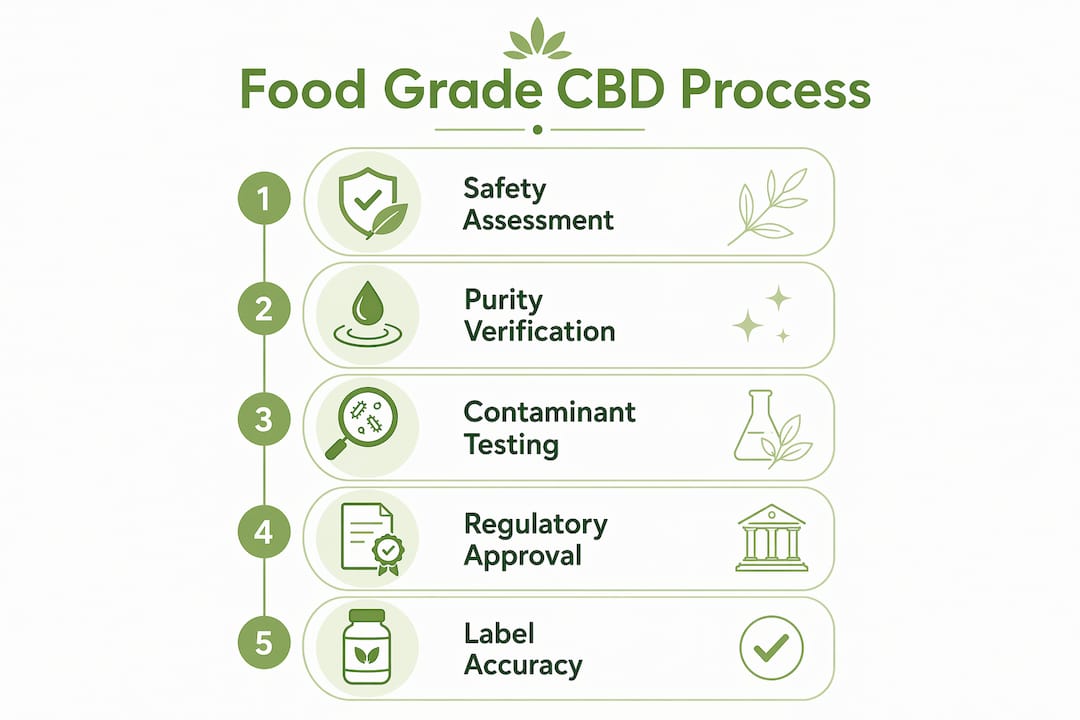
The novel food framework is the legal mechanism that governs food grade CBD authorization in the UK and EU. Under EU Regulation 2015/2283, any food ingredient without a significant history of consumption before may 1997 requires a safety assessment before it can be sold. CBD meets that definition. The process follows a structured sequence.
- Application submission. A manufacturer submits a dossier to the relevant authority (FSA, FSS, or EFSA) containing safety data, production methods, purity specifications, and proposed use levels.
- Safety assessment. Regulators review the dossier and assess risks including toxicology, contaminant profiles, and exposure estimates across the target population.
- ADI determination. If the evidence supports authorization, regulators set a provisional ADI. For CBD isolate at ≥98% purity, the FSA and FSS have set this at 10 mg per day for adults.
- Product-specific authorization. Approval is tied to specific product categories, such as food supplements, and does not automatically extend to general foods like beverages or baked goods.
- Vulnerable group exclusions. Authorizations explicitly exclude pregnant women, lactating women, and immunosuppressed persons from the authorized use population. These groups face different risk profiles that the standard safety assessment does not cover.
- Ongoing compliance. Any change to the product formulation, source material, or intended use requires reassessment or a new authorization application.
The practical implication is that food grade CBD authorization is narrow and product-specific. A CBD isolate authorized for use in food supplements at 10 mg/day is not automatically authorized for use in a sports drink or a cookie at the same dose. Each application is evaluated on its own terms.
Why do accurate labeling and verified testing matter for food grade CBD?
Mislabeling is the single biggest gap between food grade CBD claims and food grade CBD reality. A 2026 peer-reviewed study using HPTLC found that only 20% of tested CBD products met label accuracy criteria, with 70% exceeding their declared CBD content. Exceeding declared content sounds like a bonus, but it means consumers are unknowingly taking more CBD than the label states, which can push total daily intake above the provisional ADI.
For food grade claims to hold up, the following practices are non-negotiable:
- Validated analytical methods. HPTLC and HPLC are the accepted methods for potency verification. Results from unvalidated or in-house tests do not satisfy regulatory requirements.
- Batch-level COAs. A single COA for a product line is not sufficient. Each production batch needs its own certificate tied to that batch's lot number.
- Public COA access. Consumers should be able to access COAs without requesting them. Transparency at this level is a signal of genuine compliance, not just marketing.
- Label-to-COA cross-checking. The CBD content on the label must match the COA within an acceptable tolerance. Significant deviations indicate either poor manufacturing controls or deliberate misrepresentation.
Pro Tip: Always match the batch number on your product to the batch number on the COA. If those numbers do not align, the COA does not apply to what you are holding.
Mislabeling also undermines the entire food grade framework. If a product claims food grade status but its actual CBD content is 40% higher than declared, the consumer is operating outside the authorized safety window without knowing it. Verified testing is not a nice-to-have. It is the mechanism that makes food grade claims meaningful. You can review lab reports and COAs from Kingbuddha to see what genuine testing transparency looks like in practice.
Practical implications of food grade CBD standards for consumers and manufacturers
Understanding food grade CBD quality standards changes how you read a label and how you choose a product. The provisional ADI of 10 mg/day applies to aggregate intake from all sources combined. That means if you take a CBD food supplement and consume a CBD-infused beverage on the same day, both sources count toward your daily total. Regulators calculate exposure across all edible CBD sources, not per product.
| Consideration | Consumers | Manufacturers |
|---|---|---|
| Daily intake limit | Stay within 10 mg/day total from all CBD food sources | Formulate products so a single serving does not exceed the authorized dose |
| Label accuracy | Cross-check COA batch numbers against product labels | Conduct batch testing and publish COAs for every production run |
| Vulnerable groups | Pregnant, lactating, or immunosuppressed individuals should avoid food grade CBD products | Clearly exclude vulnerable groups in product labeling and marketing |
| Product category | Check whether the product is authorized as a food supplement or general food | Obtain category-specific authorization before expanding into new food formats |
| Formulation changes | Ask manufacturers if reformulations have been reassessed | Submit a new authorization application for any change in source, purity, or use level |
The food supplement category currently holds the clearest regulatory pathway for CBD in the UK and EU. General food categories like beverages and snacks face a more complex authorization process because exposure estimates are harder to control. Manufacturers who want to expand into those categories need separate assessments, not extensions of existing supplement authorizations.
For consumers, the most practical step is reading the label with the ADI in mind. A product listing 25 mg of CBD per serving is not food grade compliant at the 10 mg/day ADI, regardless of what the packaging says. Purity alone does not make a product food safe. Dose matters equally.
Key Takeaways
Food grade CBD standard is a regulatory designation requiring ≥98% CBD purity, verified contaminant testing, and compliance with a provisional ADI of 10 mg/day, not a self-applied marketing claim.
| Point | Details |
|---|---|
| Regulatory definition | Food grade CBD requires formal novel food authorization, not just a purity claim on packaging. |
| Purity threshold | Regulators set the minimum at ≥98% CBD isolate; EFSA's synthetic CBD standard requires ≥99.5%. |
| Daily intake limit | The provisional ADI is 10 mg/day for adults, calculated across all CBD food sources combined. |
| Label accuracy gap | Only 20% of tested CBD products met label accuracy criteria in a 2026 study, making COA verification critical. |
| Vulnerable group exclusions |
Pregnant, lactating, and immunosuppressed individuals are excluded from food grade CBD authorizations. |
The part most CBD buyers never think about
The regulatory framework around food grade CBD is genuinely well-constructed. The FSA and EFSA have done serious scientific work to set purity thresholds and intake limits that reflect real toxicological data. What frustrates me is how rarely that work reaches the people buying CBD products.
Most buyers focus on milligrams per bottle. They do not think about whether the product has been through a novel food assessment, whether the COA matches their specific batch, or whether their total daily intake from all sources stays within the authorized window. That gap between regulatory rigor and consumer awareness is where most CBD safety problems actually live.
The uncomfortable truth is that "food grade" printed on a label means nothing without the authorization paperwork behind it. Regulators cannot police every product claim in real time. That responsibility falls on you as the buyer. Asking for a COA, checking the batch number, and understanding the 10 mg/day ADI are not advanced moves. They are the baseline for buying CBD responsibly.
What I have seen work consistently is buying from brands that publish COAs without being asked, state their purity specifications clearly, and do not make dose claims that exceed the authorized ADI. That behavior signals a manufacturer who understands the regulatory framework, not just the marketing opportunity.
— Juiced
Kingbuddha's approach to quality and verified CBD products
Kingbuddha builds its product line around the same principles that define food grade CBD quality standards: verified purity, transparent testing, and honest labeling. Every product goes through third-party lab testing, and the results are available for you to review before you buy.
If you want CBD products backed by real testing data, Kingbuddha's CBD Sleep Support Gummies and Custom CBD Gummies are formulated with purity and dose accuracy in mind. Each batch is tested for potency and contaminants, so you know exactly what you are getting. Transparency is not a feature at Kingbuddha. It is the standard.
FAQ
What does food grade CBD mean exactly?
Food grade CBD is a CBD ingredient that has been formally assessed and authorized by a regulatory body such as the FSA or EFSA for safe use in food products. Authorization requires a purity of at least 98% and compliance with a provisional acceptable daily intake of 10 mg per day for adults.
Is CBD considered food safe by regulators?
CBD isolate at ≥98% purity is provisionally authorized as food safe for adults in food supplements under UK and EU novel food regulations, subject to a 10 mg/day intake limit. Vulnerable groups including pregnant and lactating women are excluded from this authorization.
How do I know if a CBD product meets food grade standards?
Check the product's COA for batch-specific purity and contaminant results, confirm the CBD content matches the label within an acceptable tolerance, and verify the product has been assessed under a novel food authorization framework.
What is the difference between food grade and regular CBD?
Food grade CBD has passed a formal regulatory safety assessment with defined purity and intake limits. Regular CBD products may meet quality standards without having undergone novel food authorization, meaning their safety at specific doses has not been formally evaluated by a regulatory body.
Why does the 10 mg/day ADI matter for CBD buyers?
The provisional ADI of 10 mg per day represents the total CBD intake from all food and supplement sources that regulators consider safe for adults. Consuming multiple CBD products in one day means your combined intake counts toward this limit, not each product separately.