

CBD vs THC for Sleep: Key Differences Explained
TL;DR:
- CBD helps improve sleep by reducing anxiety and physiological hyperarousal without suppressing REM sleep. THC acts as a sedative at
- low doses to shorten sleep onset but suppresses REM sleep and builds tolerance quickly. The best cannabinoid choice depends on the specific sleep problem, with CBD suited for anxiety-driven insomnia and THC benefiting those needing help falling asleep.
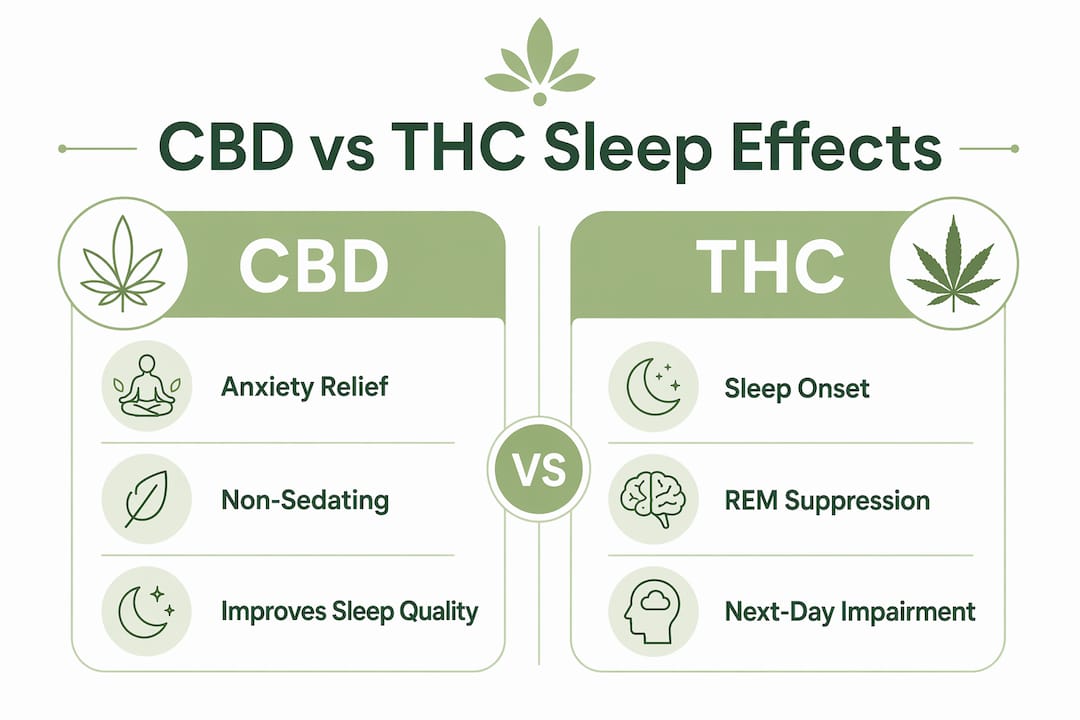
CBD and THC produce fundamentally different effects on sleep, and understanding the difference between CBD and THC for sleep is the single most useful thing you can do before choosing a cannabinoid product. THC is a direct sedative that shortens the time it takes to fall asleep but suppresses REM sleep and builds tolerance quickly. CBD is not sedating at all. It improves sleep by reducing anxiety and physiological hyperarousal, leaving your sleep architecture intact. These two mechanisms are not interchangeable, and picking the wrong one for your specific sleep problem can make things worse, not better.
What is the difference between CBD and THC for sleep?
CBD and THC are both cannabinoids derived from the cannabis plant, but they work through entirely different pathways in the brain. THC binds directly to CB1 receptors in the central nervous system, producing sedation, euphoria, and altered perception. CBD does not bind strongly to CB1 receptors. Instead, it works indirectly through anxiolytic pathways, reducing the cognitive and physiological hyperarousal that keeps people awake.
This distinction matters more than most people realize. If your sleep problem is that you cannot fall asleep because your mind races, THC will knock you out faster. If your sleep problem is rooted in anxiety or chronic stress, CBD addresses the actual cause. Using THC for anxiety-driven insomnia can mask symptoms while creating new ones, including REM suppression and next-day grogginess.
The 2018 Farm Bill legalized hemp-derived CBD products containing less than 0.3% THC at the federal level. That legal boundary also defines the practical difference in how these cannabinoids are sold and used. THC products remain regulated at the state level, while CBD products are widely available without a prescription.
How does THC affect sleep?
THC has a biphasic effect on sleep: low doses promote sleep onset, while moderate to high doses suppress REM sleep and may cause restlessness. That dose-response curve is the most important thing to understand about using THC for sleep.
THC and sleep onset
Low doses of THC in the range of 2.5–5 mg reduce sleep onset latency effectively with minimal next-day impairment. That means you fall asleep faster without feeling foggy the next morning. Doses above 15 mg consistently alter sleep architecture in ways that reduce sleep quality over time.
REM suppression and memory
Chronic THC use above 15 mg consistently suppresses REM sleep, the stage responsible for memory consolidation and emotional processing. Less REM sleep means you wake up feeling less restored, even if you slept for eight hours. People who stop THC after regular use often experience a rebound effect, with vivid or disturbing dreams as REM sleep returns.
Tolerance builds fast
Tolerance to THC's sedative effects develops rapidly due to CB1 receptor downregulation. Your body adjusts to the presence of THC and requires more of it to produce the same effect. This creates a cycle where you need higher doses to sleep, which worsens REM suppression and increases the risk of side effects.
Key risks of regular THC use for sleep:
- Reduced REM sleep affecting memory and mood
- Tolerance requiring dose escalation
- Rebound insomnia and vivid dreams when stopping
- Next-day cognitive impairment at higher doses
- Higher rates of adverse events compared to placebo
Pro Tip: If you use THC for sleep, take a break every two to three weeks. This allows CB1 receptors to reset and helps you maintain effectiveness at lower doses.
For a deeper look at how THC interacts with sleep stages, the THC and sleep guide at Kingbuddha covers the pharmacology in plain language.
How does CBD help with sleep?
CBD improves sleep mainly by reducing anxiety and physiological arousal, which are among the most common causes of insomnia. This is not sedation. CBD does not make you drowsy the way THC or pharmaceutical sleep aids do. It removes the barrier to sleep rather than forcing sleep to happen.

CBD and anxiety-driven insomnia
Research shows that 300 mg of CBD daily produced greater improvement in sleep disturbances compared to 50 mg in adults with high trait worry over a two-week period. That finding points to something counterintuitive: CBD often requires a higher dose than people expect to produce therapeutic effects. A 25 mg gummy before bed may not move the needle for someone with significant anxiety.
What CBD does not do
CBD does not suppress REM sleep. It does not produce intoxication. It does not create the kind of tolerance that requires dose escalation. These are meaningful advantages for anyone who needs to function clearly the next day or who has concerns about dependency.
CBD sleep benefits that set it apart from THC:
- No REM suppression
- No intoxication or next-day impairment
- No significant tolerance development
- Suitable for anxiety-driven insomnia
- Compatible with most daily routines
Pro Tip: Take CBD 30–60 minutes before bed and pair it with a consistent wind-down routine. CBD works best when anxiety reduction is already in motion, not as a last-minute fix.
For a thorough breakdown of CBD for insomnia, Kingbuddha's guide covers mechanisms, dosing, and product selection in detail.
CBD vs THC for sleep: who benefits from each?
The right cannabinoid depends entirely on the nature of your sleep problem. THC and CBD serve different people with different needs.
| Sleep issue | Better cannabinoid | Key reason |
|---|---|---|
| Trouble falling asleep | THC (low dose) | Reduces sleep onset latency directly. |
| Anxiety-driven insomnia | CBD | Reduces hyperarousal without sedation. |
| Chronic pain disrupting sleep | THC or combined formula | Sedative and analgesic properties. |
| PTSD-related nightmares | THC (with caution) | REM suppression reduces nightmare frequency. |
| General stress and poor sleep quality | CBD | Addresses the root cause without side effects. |
| Sleep maintenance issues | CBD + CBN combination | Improves sleep continuity without THC risks. |
CBN combined with CBD improved sleep maintenance without the adverse effects associated with THC in controlled trials. CBN is gaining consumer interest as a third option, though clinical evidence for CBN remains limited and preliminary. The combination of CBD and CBN may outperform either cannabinoid alone for people who struggle to stay asleep through the night.
Cannabinoids overall show some evidence of increasing total sleep time, but with a higher risk of adverse side effects. That finding from a 2026 meta-analysis reinforces the importance of starting low and choosing the right cannabinoid for your specific situation.
Dosage and safety tips for using cannabinoids for sleep
Getting the dose right is where most people go wrong. Too little CBD produces no effect. Too much THC disrupts sleep quality and builds tolerance.
Practical guidance for both cannabinoids:
- Start with low THC doses. Begin at 2.5 mg and increase slowly. Doses of 2.5–10 mg cover most sleep onset needs without significant next-day impairment.
- Use higher CBD doses for anxiety. Therapeutic CBD doses range from 25 mg up to 300 mg depending on the severity of anxiety and sleep disruption. Most over-the-counter products fall in the 25–50 mg range per serving.
- Time your dose correctly. Take THC 30–45 minutes before bed. Take CBD 30–60 minutes before bed to allow anxiolytic effects to build.
- Cycle THC use. Avoid daily THC use for sleep. Tolerance develops within weeks, and dose escalation worsens outcomes over time.
- Choose the right product format. Tinctures absorb faster than gummies. Gummies provide longer-lasting effects. Hemp flower acts quickly but requires inhalation, which is not suitable for everyone.
- Check for interactions. CBD inhibits certain liver enzymes and can affect the metabolism of other medications. Consult a healthcare provider if you take prescription drugs.
Pro Tip: Keep a simple sleep log for the first two weeks of using any cannabinoid. Note your dose, timing, how long it took to fall asleep, and how you felt in the morning. Patterns emerge quickly and help you adjust without guesswork.
Hemp-derived cannabinoids and sleep vary significantly by individual, so tracking your own response is more reliable than following a generic dosing chart.
Key Takeaways
CBD and THC improve sleep through opposite mechanisms, making the right choice entirely dependent on the root cause of your sleep problem.
| Point | Details |
|---|---|
| THC reduces sleep onset | Low doses of 2.5–5 mg shorten the time to fall asleep with minimal next-day impairment. |
| THC suppresses REM sleep | Doses above 15 mg reduce REM sleep, impairing memory consolidation and emotional processing. |
| CBD works through anxiety reduction | CBD improves sleep indirectly by lowering hyperarousal, not by inducing sedation. |
| CBD requires adequate dosing | Therapeutic effects for anxiety-driven insomnia may require doses up to 300 mg daily. |
| CBN adds a third option | CBD combined with CBN improves sleep maintenance without the tolerance risks of THC. |
What I've learned from watching people choose the wrong cannabinoid
The most common mistake I see is people reaching for THC because it feels like the obvious sleep aid. It works fast, it feels like it's doing something, and the first few nights are genuinely better. Then tolerance sets in, doses creep up, and sleep quality quietly deteriorates. People blame stress or age or their mattress. They rarely connect it to the cannabinoid.
CBD gets dismissed because it does not produce an obvious sedative sensation. People try 25 mg, feel nothing dramatic, and conclude it does not work. The reality is that CBD's effect is subtle by design. You do not feel it working. You just notice, a few nights in, that your mind is quieter when you lie down.
The research on cannabinoids for sleep and stress consistently points to one conclusion: match the cannabinoid to the mechanism of your sleep problem. THC is a blunt instrument that works well for specific situations, particularly chronic pain or PTSD. CBD is a more precise tool for the majority of people whose sleep suffers because their nervous system will not quiet down.
CBN is worth watching. Early data on CBD and CBN combinations is promising, and I expect clinical evidence to strengthen over the next few years. For now, a full-spectrum CBD product that includes trace CBN is a reasonable starting point for most people.
The most important thing is to monitor your own response honestly. If your sleep quality is not improving after two weeks, the dose or the cannabinoid is wrong. Adjust one variable at a time.
— Juiced
Kingbuddha's sleep-focused cannabinoid products
Kingbuddha carries a full range of cannabinoid products built specifically for sleep support, from non-intoxicating CBD options to balanced THC formulas for those who need a stronger effect.

The CBD Sleep Support Gummies are a straightforward starting point for anyone dealing with anxiety-driven insomnia. For those who want the synergistic effect of CBD and CBN together, the Sleep CBD Tincture with CBN delivers 1,500 mg of full-spectrum cannabinoids in a 30 ml bottle. Every Kingbuddha product is third-party tested, made with U.S.-sourced hemp, and compliant with the 2018 Farm Bill. Browse the full CBD sleep product line to find the format and potency that fits your routine.
FAQ
What is the main difference between CBD and THC for sleep?
THC is a direct sedative that shortens sleep onset time but suppresses REM sleep. CBD is not sedating but improves sleep by reducing anxiety and physiological hyperarousal without disrupting sleep architecture.
Does THC or CBD work better for insomnia?
It depends on the cause. THC works better for sleep onset problems and pain-related insomnia. CBD works better when insomnia is driven by anxiety, stress, or an overactive mind.
Can you take CBD and THC together for sleep?
Yes. Combined formulas allow lower THC doses, which reduces REM suppression and tolerance risk while CBD addresses the anxiety component. A balanced ratio is often more effective than either cannabinoid alone.
How much CBD do you need for sleep?
Therapeutic doses for anxiety-driven sleep disturbances range from 25 mg to 300 mg daily. A 2026 clinical trial found that 300 mg produced greater improvement in sleep disturbances than 50 mg in adults with high trait worry.
Does THC tolerance affect sleep quality?
Yes. Tolerance to THC's sedative effects develops rapidly due to CB1 receptor downregulation. As doses increase to compensate, REM suppression worsens and adverse effects become more likely. Cycling off THC periodically helps reset tolerance.