

7 Day Test Reveals When to Take CBD for Sleep, Anxiety, and Focus
The best time to take CBD depends on what you're treating: morning works for low doses aimed at daytime calm or focus, evening suits higher doses meant to help you sleep, and pain or chronic symptoms often respond better to splitting a dose between both. Onset time matters more than the clock, though. A tincture kicks in within 30 to 45 minutes; a gummy can take 90 minutes or longer. Pick a schedule, stick with the same dose and product for at least a week, and judge results from there rather than chasing a perfect hour.
TL;DR:Kingbuddha
- CBD dosing and timing should match the specific goal, such as morning alertness, midday stress, or evening sleep aid, with onset times varying by product form.
- Sublingual tinctures absorb fastest (15-45 minutes) and are ideal for testing precise timing, while edibles and capsules have delayed onset but longer-lasting effects.
- Consistent use and sticking with the same product and schedule for at least a week are more effective than trying to find the perfect hour or making frequent changes.
- Starting with low doses (5-25 mg) and recording effects helps determine personal timing, but high doses (over 200 mg) generally have weaker or inconsistent effects.
- Always choose products with third-party lab reports and consult a healthcare professional before combining CBD with prescription medications.
Table of Contents
- When Should You Take CBD Oil for Different Goals?
- How CBD Works: Onset Times and Dosing Science
- Does Product Form Change When You Should Take CBD?
- Should You Take CBD With Food, and What Else Matters for Safety?
- How Do You Find the Right CBD Timing for You?
- Why Consistency Beats the Perfect Hour
- Start Your CBD Timing Test With the Right Product
- Sources
- FAQ
When Should You Take CBD Oil for Different Goals?
Timing only works if it matches what you're trying to fix. Someone managing daytime anxiety needs a different window than someone trying to fall asleep faster, and dose matters just as much as the clock.
Morning dosing tends to work best at low amounts, generally at low doses associated with alerting effects. At this range, many people report a subtle alerting effect rather than drowsiness, which is one reason morning users often stick to smaller servings. Some research into dose-dependent effects suggests this wake-promoting pattern shows up consistently at lower doses, while sedation becomes more likely as the amount climbs. If your goal is baseline anxiety control or steadier focus through a workday, starting low in the morning avoids the grogginess that can come with a bigger dose.
Midday or situational dosing fits people managing a specific stressor, like a presentation, a flight, or a difficult conversation. Timing here depends heavily on product form:
- Tinctures: take 30 to 60 minutes before the event
- Gummies or capsules: take 60 to 90 minutes before, since digestion slows absorption
- Vapes: effects show up in minutes, useful only for acute, short-lived stress
Evening or bedtime dosing usually calls for a longer runway and, for many people, a higher dose than they'd use in the morning. Oils and tinctures held under the tongue generally need 30 to 45 minutes to take effect. Gummies need more lead time, often 60 to 90 minutes or more, because they have to pass through digestion first. If you're using CBD specifically as a sleep aid, that lag matters. Taking a gummy at 10:45 p.m. and expecting to feel it by 11:00 sets you up for disappointment.
Split dosing solves a different problem: coverage. Chronic pain or persistent anxiety doesn't stay put in a 12-hour window, so many people split a daily total into two servings, one on waking and one before bed, rather than taking it all at once. This mirrors how the FDA-approved medication EPIDIOLEX is prescribed, on a twice-daily schedule rather than a single large dose. A single big dose in the morning or evening can create a spike, then a trough, while your body waits for the next serving. Splitting the total smooths that curve out.
How CBD Works: Onset Times and Dosing Science
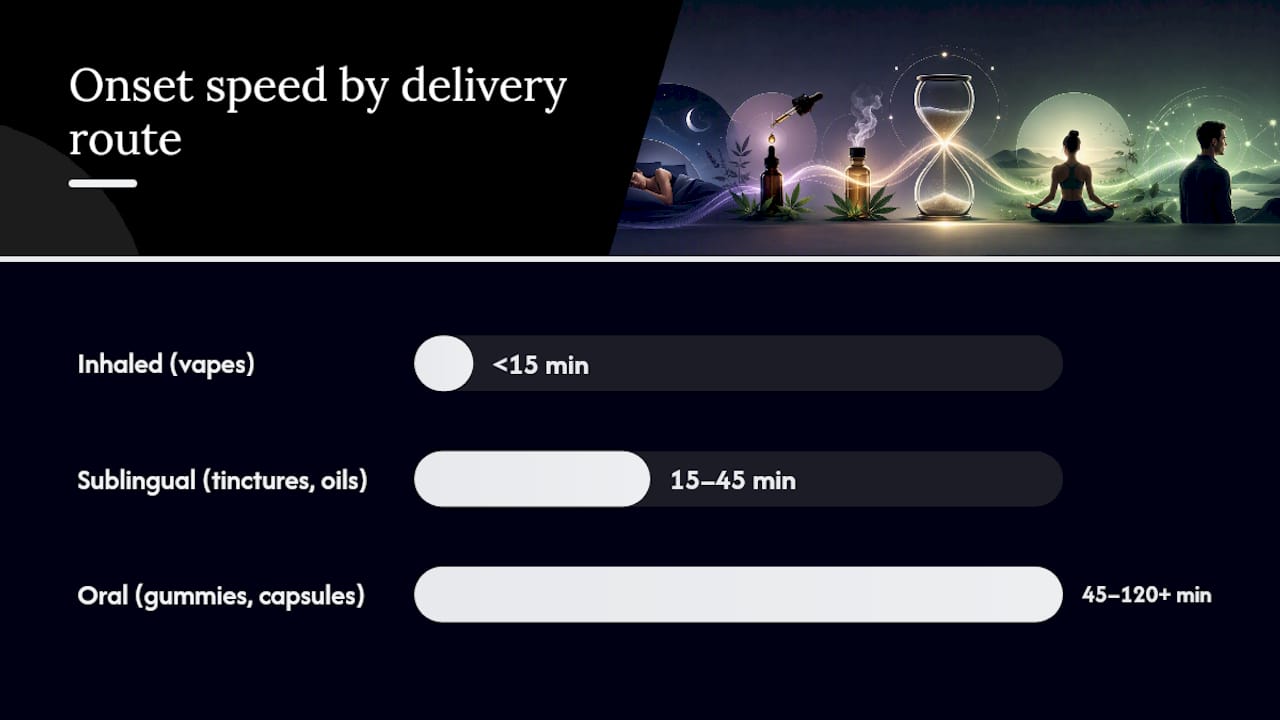
How fast CBD hits your system depends entirely on the route it takes into your bloodstream. Sublingual tinctures held under the tongue absorb through tissue there, producing effects in roughly 15 to 45 minutes. Edibles and capsules travel through the digestive tract and liver first, pushing onset out to 45 minutes or beyond, sometimes past two hours for a full effect. Inhaled products, vapes primarily, hit fastest, often under 15 minutes, but the effect fades quicker too.
Onset and duration by route:
- Sublingual (tinctures, oils): 15 to 45 minutes onset, effects lasting 4 to 6 hours
- Oral (gummies, capsules): 45 to 120+ minutes onset, effects lasting 6 to 8 hours
- Inhaled (vapes): under 15 minutes onset, effects lasting 2 to 3 hours
- Topical: localized only, no systemic onset window applies
Pro Tip: If you're testing CBD for the first time, start with a tincture rather than a gummy. The faster feedback loop makes it much easier to link cause and effect, and you'll waste less time waiting to find out if a dose was too low.
Dose matters as much as delivery method, and the relationship isn't a straight line. Some clinical research on CBD points to an inverted U shaped pattern: doses around 300 to 600 mg produced measurable anxiety reduction in single-dose studies, while both smaller and larger amounts sometimes showed weaker or inconsistent effects. A separate randomized crossover trial found that a single 200 mg dose of synthetic CBD produced a slight but perceptible pleasant effect compared with a placebo, while doses of 100 mg or less were unlikely to produce any noticeable psychoactive effect. None of this means more is automatically better. It means the dose-response curve is genuinely biphasic, and jumping straight to a high dose because "it should work faster" often backfires into unwanted sedation.
A broader review of CBD clinical studies found real variation across dose, formulation, and study quality, which is exactly why the EPIDIOLEX label leans so heavily on consistency: same dose, twice daily, taken the same way relative to food, every single day. That instruction wasn't written for recreational wellness users, but the underlying logic translates directly. Dose and timing aren't separate variables. They interact.
Does Product Form Change When You Should Take CBD?
Product form changes the entire timing equation, not just the speed of onset. Sublingual tinctures and isolates absorb fastest and give you the most control over dose, which makes them the easiest starting point if you're trying to figure out your own personal timing.
- Tinctures and isolates: fast onset, precise titration, ideal for testing different schedules
- Gummies and capsules: slower, longer-lasting, better suited to evening use where the delayed onset lines up with bedtime rather than working against it
- Vapes and inhalables: near-immediate but short-lived, useful for acute stress spikes, not a good first-line choice for sleep since the effect wears off before morning
- Topicals and transdermals: stay localized to the skin and muscle tissue where applied; they don't produce the systemic effects needed for anxiety or sleep, so timing them around a daily schedule doesn't apply the same way
Full-spectrum products add another layer. Beyond CBD itself, they carry trace cannabinoids and terpenes, some of which (like myrcene or linalool) have their own mild sedating reputation. That's part of why a full-spectrum tincture taken at night can feel noticeably different from an isolate taken at the same dose in the morning. If you're timing around sleep specifically, a full-spectrum product with that kind of terpene profile is worth trying before assuming you need a higher CBD dose.
Pro Tip: Keep a single variable in motion at a time. If you switch from an isolate tincture to a full-spectrum gummy and change your timing in the same week, you won't know which change actually caused the result.
Should You Take CBD With Food, and What Else Matters for Safety?
Food changes how much CBD actually reaches your bloodstream, sometimes dramatically. High-fat meals can substantially raise plasma exposure compared with taking CBD on an empty stomach, which is exactly why the EPIDIOLEX label recommends dosing consistently with respect to meals. If you take it with breakfast one day and on an empty stomach the next, you're not testing timing, you're testing two different doses in disguise.

Medication interactions deserve equal attention. CBD inhibits certain liver enzymes in the CYP family, the same pathway responsible for metabolizing a long list of prescription drugs including blood thinners and anticonvulsants. If you take any major prescription medication, particularly anticoagulants or seizure medication, talk to a clinician before adding CBD to your routine, regardless of what time of day you plan to take it.
Safety checklist before you start:
- Confirm the product carries a current third-party lab report (COA) verifying potency and screening for contaminants
- Ask a doctor about interactions if you take blood thinners, anticonvulsants, or other daily prescriptions
- Avoid CBD during pregnancy or breastfeeding
- Stop and consult a doctor if you notice unexplained sedation, yellowing skin or eyes, or other unusual symptoms
Supplement contamination is a real risk worth taking seriously. CBD products aren't broadly regulated by the FDA the way prescription drugs are, and independent testing has turned up products contaminated with THC beyond legal limits or containing far less CBD than labeled. Mayo Clinic's Dr. Bhanuprakash Kolla has pointed out there's no definitive evidence CBD outperforms other sleep aids, and that the lack of oversight makes third-party testing non-negotiable rather than optional. Choosing a product with a published certificate of analysis cuts that risk considerably.
How Do You Find the Right CBD Timing for You?
No clinical trial has directly compared morning versus evening CBD dosing for common consumer products, which means the honest answer is that you have to test it yourself. The good news is that a short, structured trial gets you a reliable answer in about two weeks.
- Pick one goal (sleep, daytime calm, or focus) and one clock slot, then hold your dose, meal timing, and product identical for seven days straight.
- Ignore days one through three. Early results are often just carryover from prior use or simple novelty, not the real signal.
- Log how you feel at 30, 60, and 120 minutes after dosing, along with any side effects.
- If you want to compare two time slots, run two separate seven-day blocks and only compare days four through seven of each.
Pro Tip: Write down the batch number from your product's COA each time you log a result. If you switch bottles mid-test, that number tells you whether a change in effect came from a new batch rather than a change in timing.
Why Consistency Beats the Perfect Hour
Chasing an ideal hour is largely a distraction. What actually produces a reliable, repeatable result is doing the same thing at the same time with the same product for long enough to see a real pattern, since pharmacokinetic carryover can easily confound a single day's impression. Some companies build their approach around the principle of lab-verified, U.S.-sourced products with published COAs, because timing advice is only as good as the product behind it.
— Juiced
Start Your CBD Timing Test With the Right Product
Testing timing only works if the product itself stays consistent and clean, which is where a lot of DIY experiments quietly fail. Kingbuddha sources its CBD from U.S. farms and publishes third-party lab results on every product, so when you're running a seven-day trial, you know the dose on the label is the dose in the bottle.

If your goal is sleep, the CBD Sleep Support Gummies are built for an evening slot, formulated with the longer, steadier release that bedtime dosing calls for. If you want faster feedback while you're still figuring out your ideal window, CBD Tinctures absorb quickly and let you titrate in small, precise steps. For localized aches that don't need a systemic timing plan at all, the Topicals line applies directly where it hurts. Start with a low-dose product, follow the seven-day protocol above, and check the COA on whatever you choose before your first dose.
Sources
- Dose–response patterns in cannabidiol studies (UNM repository)
- 2026 randomized crossover trial on single-dose synthetic CBD
- Systematic review of CBD clinical studies (PMC7092763)
This article is general information, not a substitute for advice from a qualified doctor. Consult a qualified healthcare professional about your own circumstances before acting on anything here.
FAQ
Should you take CBD in the morning or evening?
It depends on the goal: morning suits low doses for daytime calm or focus, while evening suits higher doses aimed at sleep. Many people managing chronic pain split their dose between both, taking advantage of a twice-daily pattern similar to what the EPIDIOLEX label recommends.
What should you not mix CBD with?
Avoid combining CBD with blood thinners, anticonvulsants, and other medications metabolized by the liver's CYP enzymes without talking to a doctor first, since CBD can inhibit that pathway and change how those drugs work. Alcohol and other sedatives can also compound CBD's sedating effects at higher doses.
Does CBD help with cortisol?
Some research points to CBD reducing acute anxiety responses at specific single doses, which theoretically could ease stress-related cortisol spikes, but dose-response data shows an inverted U pattern rather than a straightforward reduction at any dose. There's no established consumer dosing standard proven to lower cortisol directly, so this remains an area needing more research.
How soon does CBD kick in?
Sublingual tinctures typically take 15 to 45 minutes to take effect, while gummies and capsules can take 45 minutes to two hours because they pass through digestion first. Vapes act fastest, often within 15 minutes, but the effect fades much sooner too.
How much CBD should you take to start?
Most people new to CBD start in the 5 to 25 mg range and adjust slowly from there, since a 200 mg single dose produced only a small, measurable effect in one trial and lower doses often produce no noticeable effect at all. Kingbuddha's current product lineup and pricing are listed on the Kingbuddha site, where each item includes its published lab report.