

Pack CBD Gummies for U.S. Flights: 6 Steps to Pass TSA With a COA
Yes, you can generally fly within the U.S. That said, the final call always belongs to the TSA officer at the checkpoint, and state law can complicate things once you land. Keep the gummies in their original packaging with a lab report on hand, and you'll clear most checkpoints without a second look.
TL;DR:
- TSA's screening mainly checks for security threats; most hemp-derived gummies under 0.3% delta-9 THC pass through without issue, but packaging and documentation are crucial.
- The federal limit of 0.3% delta-9 THC, established by the 2018 Farm Bill, does not guarantee state law compliance or prevent local law enforcement from confiscation.
- Carrying lab-tested products with clear Certificates of Analysis, original labeled packaging, and a purchase receipt significantly reduces the risk of confiscation or delays.
- Traveling with hemp products across state lines or internationally is risky; buying compliant products at the destination is the safest approach.
- International flights prohibit CBD even if legal at home, and unverified or unlabeled products are at the highest risk of seizure or criminal penalties.
Table of Contents
- Flying With CBD Gummies: What TSA's Rules Actually Say
- The 2018 Farm Bill and Why 0.3% Is the Magic Number
- Do State Cannabis Laws Apply at the Airport?
- How to Pack CBD Gummies for a Flight, Step by Step
- What Happens if TSA or Police Stop You With CBD Gummies
- Never Fly Internationally With CBD, Even If It's Legal at Home
- What a Travel-Ready CBD Gummy Actually Looks Like
- Weighing Convenience Against Legal Risk on the Road
- Where to Find Travel-Ready CBD Gummies With Lab Reports
- Sources
- FAQ
Flying With CBD Gummies: What TSA's Rules Actually Say
TSA's own guidance is more permissive than most travelers expect. Hemp-derived products, including gummies, are allowed in carry-on and checked bags as long as they meet the federal definition of hemp: no more than 0.3% delta-9 THC by dry weight. That single number is doing all the legal work here. Cross it, even with a product marketed as "CBD," and you're carrying a federally controlled substance.
Here's the part that surprises people: TSA agents aren't drug enforcement officers, and screening a gummy for THC percentage isn't something they do at the checkpoint. Screeners look for security threats, not chemical composition. So a bag of gummies that looks like candy usually just passes through the X-ray without comment.
TSA officers aren't chemists. They're making a judgment call based on packaging, documentation, and how a product looks. That's the practical reality behind the policy.
Where things can shift is when something looks like cannabis and there's no way to quickly confirm otherwise. TSA has clarified that its officers do not go hunting for marijuana or THC products during routine screening, but if a suspected cannabis product turns up during the normal course of a bag check, the officer will refer it to local law enforcement for a final determination. That's a meaningful distinction. TSA isn't the enforcement agency here. It's a checkpoint that can hand you off to one.
A few things influence how that plays out in practice:
- Whether the gummies are in original, labeled retail packaging or a plain sandwich bag
- Whether the packaging clearly states hemp origin and THC content
- Whether the officer has seen similar products before (frequent flyers at busy hubs report fewer issues than travelers passing through smaller regional airports)
- Local law enforcement's familiarity with hemp law, which varies a lot by airport
None of that changes the federal rule. It just changes how smoothly you get through the line. The safest assumption: TSA's screening technology and staff training were not built to distinguish hemp gummies from anything else that looks like an edible, so documentation is doing more work than the rule itself.
The 2018 Farm Bill and Why 0.3% Is the Magic Number
Every rule discussed above traces back to one law. The Agriculture Improvement Act of 2018, commonly called the Farm Bill, removed hemp from the Controlled Substances Act and defined it as cannabis containing no more than 0.3% delta-9 THC by dry weight. Anything below that threshold is legally hemp. Anything above it is marijuana under federal law, regardless of what the label says or how it's marketed.
That distinction sounds simple, but it creates a gap a lot of travelers fall into. The Farm Bill did not make every CBD product legal everywhere. Brookings' explainer on the law notes that implementation has stayed messy: interstate commerce is federally protected for compliant hemp, but individual states can still restrict or ban certain hemp derivatives, and enforcement varies by product type and state program.
A few things follow from that:
- The 0.3% threshold applies to delta-9 THC specifically, not total cannabinoid content
- A product legally sold in a dispensary under a state medical or recreational program is not automatically federally legal hemp
- "Full-spectrum," "broad-spectrum," and "isolate" labels each carry different THC risk profiles, and only lab testing confirms which one you're actually holding
This is exactly why a Certificate of Analysis matters more than the label copy on the bag. A COA from an accredited third-party lab is the only real proof that a batch falls under the federal threshold. Without one, you're relying entirely on the manufacturer's word, and that word means nothing to a police officer standing at a TSA checkpoint.
Do State Cannabis Laws Apply at the Airport?
Airports sit on federal property and operate under federal jurisdiction, which means a state medical card or a recreational purchase receipt from a legal dispensary carries zero weight at a TSA checkpoint. This catches a lot of travelers off guard, especially those flying out of states with mature legal cannabis markets who assume their home-state legality travels with them. It doesn't.
What actually happens if a product raises questions depends heavily on where you are:
- In cannabis-friendly states, local police who respond to a TSA referral often verify the product is compliant hemp and let you proceed, sometimes with a warning
- In stricter states, the same product might get confiscated on the spot, even if it's legitimately under 0.3% THC
- Citations are possible but relatively uncommon for small personal quantities of clearly labeled hemp products
- Arrest is rare for hemp-derived gummies specifically, but it isn't impossible if THC content is disputed or the product is unlabeled
Practical guides on airport cannabis enforcement consistently point to the same conclusion: buying at your destination rather than transporting products across state lines is often the lowest-risk move, particularly if you're headed somewhere with unclear or restrictive hemp statutes. If you're not sure what your destination state allows, look it up before you pack, not after you land in a customs line or a rental car counter with a confiscated product and no gummies for the trip.
How to Pack CBD Gummies for a Flight, Step by Step
Getting through security without a hiccup usually comes down to preparation, not luck. Here's the sequence that minimizes friction:
- Keep gummies in their original, labeled packaging. A resealed bag or pill organizer looks suspicious no matter how legitimate the product is.
- Match the lot number on the package to a Certificate of Analysis. Most reputable brands print a batch or lot number that corresponds to a specific COA showing delta-9 THC results by dry weight.
- Print or save the COA, plus your purchase receipt. Many labels now include a QR code linking straight to the lab report. If yours does, screenshot it in case you lose signal at the airport.
- Separate gummies from any tinctures or oils. Gummies are solids and aren't subject to the 3-1-1 liquids rule, but tinctures are. Oils and tinctures need containers under 3.4 ounces, packed in your quart-sized clear bag, no exceptions for "medical" framing.
- Pack gummies in your carry-on, not checked luggage. If a question comes up, you want your documentation and the product together and accessible, not buried in a bag that already went through the loading process.
- Consider your total quantity. There's no official numeric cap on hemp CBD edibles for personal use, but a suitcase full of product reads very differently to an officer than a single resealed bag meant for a week-long trip.
Pro Tip: If your trip crosses several states with different hemp rules, stick to broad-spectrum or isolate gummies rather than full-spectrum. Isolate and broad-spectrum products carry a lower, more consistent THC profile, which gives you a cleaner story if anyone asks questions along the way.
What Happens if TSA or Police Stop You With CBD Gummies
Getting flagged doesn't automatically mean disaster. It usually means a short conversation and a request to see documentation. Here's what that typically looks like and how to handle it well.
If a screener isn't sure what they're looking at, expect a trip to secondary screening. That's a more thorough bag check, sometimes with a supervisor present. This is where your COA earns its keep: hand it over along with the original packaging, and point to the lot number that matches the batch number on the lab report. Clear labeling with a scannable QR code speeds up verification meaningfully, because whoever is checking doesn't have to take your word for it.
A few things help the interaction go smoothly:
- Stay calm and cooperative. Arguing about federal versus state law with a screener rarely helps and often escalates a routine check into something longer.
- Ask clarifying questions if you're not sure what's being requested. It's fine to ask an officer's name and agency, especially if the product is going to be confiscated.
- Keep your receipt and COA in a format you can hand over easily. A printed copy beats scrolling for a link with a weak airport Wi-Fi signal.
- If the product is taken, ask for a property receipt. That paperwork matters if you want to follow up with airport police or file a complaint with the airline afterward.
Confiscation is a real possible outcome even with fully compliant products, particularly in jurisdictions less familiar with hemp law. Losing the gummies is frustrating. Getting cited is rare. Treat the interaction as a documentation check, not an interrogation, and it usually resolves in minutes.
Never Fly Internationally With CBD, Even If It's Legal at Home
Everything above applies to domestic U.S. flights and jurisdiction. Plenty of countries classify any CBD product as a controlled substance regardless of THC content, and some carry serious criminal penalties for possession, even for what looks like an innocuous bag of gummies.
Practical travel guidance on this point is consistent: don't bring CBD products, hemp-derived or otherwise, on international flights, whether you're departing the U.S. or returning to it. If CBD is legal at your destination, buy it there once you've verified local law, rather than risking a customs seizure or worse on either end of the trip.
What a Travel-Ready CBD Gummy Actually Looks Like
Not every CBD gummy on the market is built with travel in mind, but the ones that reduce your risk share a few traits. Some companies lab-test their hemp-derived products through third-party facilities and provide Certificates of Analysis showing delta-9 THC results by dry weight, the exact documentation a TSA officer or local police department would want to see.
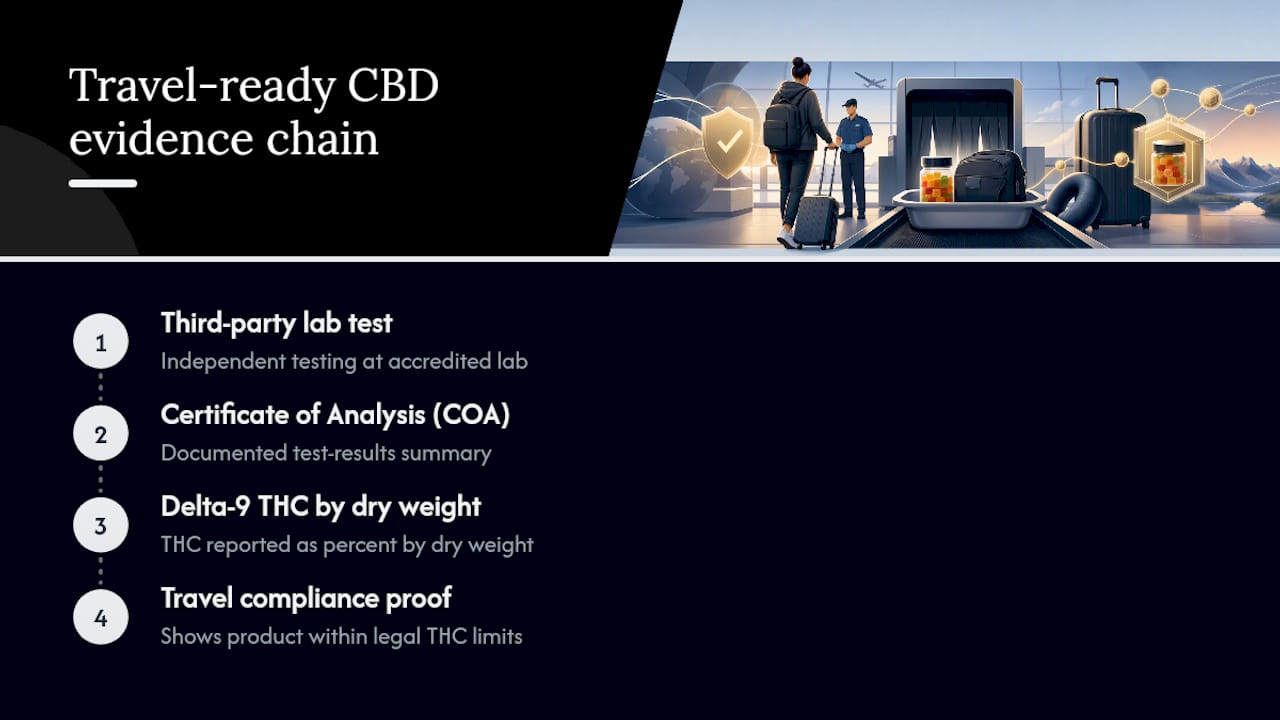
Kingbuddha's guide on how to ensure CBD product safety walks through this process in more detail, including how to spot vague or misleading lab reports that don't actually confirm compliance. If you're comparing full-spectrum versus isolate options before a trip, this breakdown of THC, CBD, and terpene testing explains why label claims alone aren't enough to trust.
Weighing Convenience Against Legal Risk on the Road
Most travelers carrying a small, clearly labeled bag of compliant hemp gummies for personal use get through security without incident. The math changes if you're crossing into a state with stricter hemp enforcement, carrying an unusually large quantity, or relying on a product with no COA at all. In those situations, the smarter move is often to leave the gummies home and buy locally once you've confirmed the destination's rules.
Isolate or broad-spectrum products, kept in original packaging with lab documentation within reach, remove most of the guesswork. That's not paranoia. It's just matching your risk tolerance to a legal system that still varies more than most people realize from one state line to the next.
— Juiced
Where to Find Travel-Ready CBD Gummies With Lab Reports
Kingbuddha's advantage for travelers isn't just legal compliance on paper. It's having the documentation ready before you ever get to the airport, so you're not scrambling for a lab report at a checkpoint.

Every batch of Kingbuddha's CBD sleep support gummies comes with third-party lab testing and a Certificate of Analysis tied to that specific lot, the kind of paperwork this guide recommends carrying on every flight. If tinctures fit your routine better than gummies, Kingbuddha's tincture collection is worth a look too, just remember those fall under the 3-1-1 liquids rule rather than the solids exemption gummies get. Before you pack for your next trip, pull up the COA for whatever product you're bringing and confirm the delta-9 THC result matches the lot number on the package. Kingbuddha's guide to staying compliant with CBD covers the rest of what to check before you fly.
Sources
- Medical Marijuana | Transportation Security Administration
- TSA Updates Cannabis Screening Policy; Here's What Happens Now · CannIntel
- Agriculture Improvement Act of 2018 (Public Law 115-334)
- Flying with Weed, Flying with Edibles, Cannabis on a Plane & TSA Cannabis Rules — Can You Fly with CBD?
FAQ
Can You Take CBD Gummies on a Plane?
flights, though the TSA officer at the checkpoint has final say.
Can You Bring CBD Gummies in a Carry-On or Only Checked Bags?
Both are allowed, but carry-on is recommended so your documentation, including a Certificate of Analysis, stays with the product in case a screener has questions.
What Happens if TSA Finds CBD Gummies That Look Like THC Edibles?
TSA doesn't actively search for cannabis, but if a suspected THC product turns up during a routine check, officers refer it to local law enforcement, who make the final determination based on state law.
Is It Legal to Fly With CBD Tinctures Instead of Gummies?
Yes, but tinctures count as liquids under TSA's 3-1-1 rule, meaning containers must be 3.4 ounces or less and fit in your quart-sized bag, unlike gummies, which face no such limit.
Can You Fly Internationally With Hemp-Derived CBD Gummies?
No.