

What Is Product Consistency in CBD? A 2026 Guide
TL;DR:
- CBD product consistency ensures uniform cannabinoid content,
- formulation quality, and dose accuracy across batches. It is measured through batch-specific Certificates of Analysis that verify potency, safety, and label accuracy. Consistency affects both efficacy and consumer trust,
- emphasizing the importance of proper formulation, third-party testing, and careful product inspection.
Product consistency in CBD is defined as the reliable uniformity of cannabinoid content, formulation quality, and dose accuracy across every batch and every serving of a product. Without it, a 25mg gummy today might deliver 18mg tomorrow. That gap is not just inconvenient. It directly affects whether a product works, whether it is safe, and whether you can trust the brand behind it. Understanding what drives CBD product consistency gives you the tools to shop smarter and get real results from your wellness routine.
What is product consistency in CBD, and why does it matter?
CBD product consistency is the industry term for batch-to-batch and dose-to-dose uniformity in cannabinoid content and formulation stability. A product is considered consistent when its actual CBD content stays within an accepted range of its labeled amount across multiple production runs. The recognized quality standard in the CBD industry allows a variation of 10–15% from the labeled cannabinoid amount before a product is considered out of spec. That window exists because hemp is a living plant, and natural variation is unavoidable.

Consistency matters because your body responds to dose, not intent. If you take CBD daily for sleep or stress, your body builds toward a steady-state level of cannabinoids over time. A product that swings wildly between batches disrupts that process. Batch-specific testing and controlled cultivation techniques like hydroponics are the manufacturing practices that keep variation within that tight window and protect the consumer experience.
The stakes go beyond personal preference. A 2023 study found that 92% of sampled UK products contained less CBD than stated on their labels. That finding reveals how common mislabeling is, even in regulated markets. For anyone using CBD as part of a structured wellness plan, that kind of inconsistency is a real problem.
How is CBD product consistency measured and regulated?
The primary tool for measuring CBD consistency is the Certificate of Analysis, or COA. A COA is a lab report from an independent, accredited testing facility that confirms the actual cannabinoid content of a specific batch. Reputable brands publish batch-specific COAs, meaning each production run gets its own test. A single COA for the entire product line tells you almost nothing about the batch in your hand.
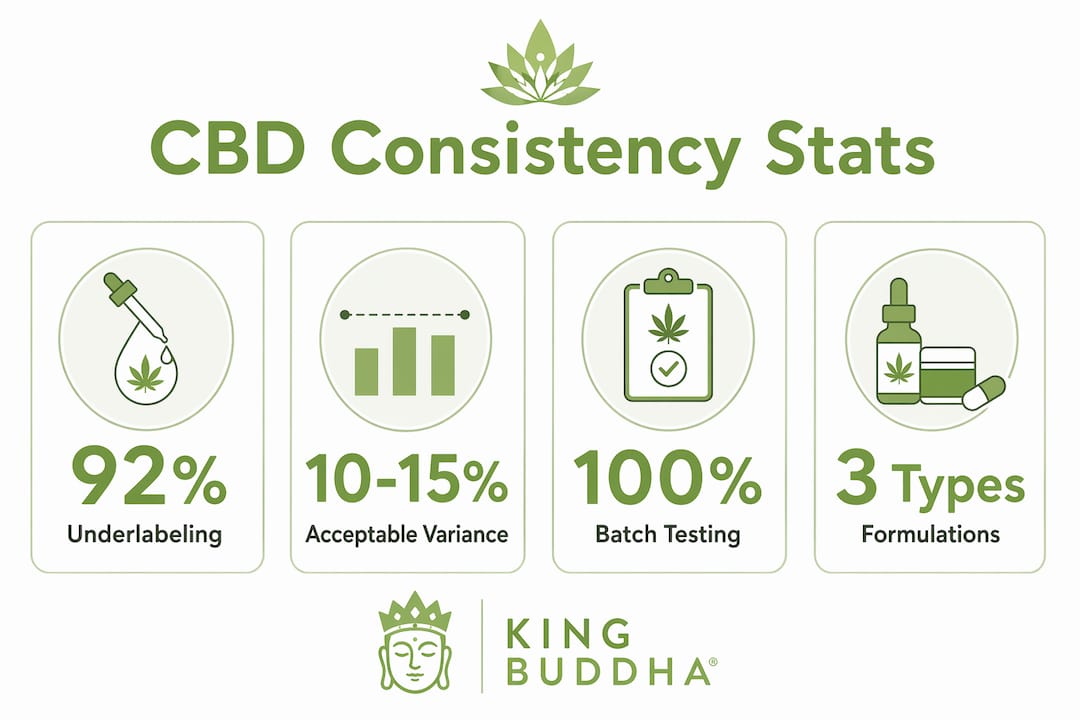
What lab testing actually confirms
A COA covers several key quality markers:
- Cannabinoid potency: Confirms actual CBD, THC, and other cannabinoid levels against the label claim.
- Contaminant screening: Tests for pesticides, heavy metals, residual solvents, and microbial contamination.
- Batch identification: Links the test results to a specific production lot, so you can verify your exact product.
- Label accuracy: Flags whether the product falls within the accepted 10–15% variance window.
| Quality Marker | What It Tells You |
|---|---|
| Cannabinoid potency | Whether the CBD content matches the label |
| Contaminant panel | Whether the product is safe to consume |
| Batch number | Whether the COA matches your specific product |
| Label variance | Whether the product meets industry accuracy standards |
Regulatory enforcement of CBD labeling remains inconsistent in 2026. The FDA has not established a formal potency standard for hemp-derived CBD products, which means quality control falls largely on manufacturers and third-party labs. A global study found that only 20% of CBD products in Costa Rica met acceptable label accuracy, with 70% exceeding their declared CBD content. Exceeding the label sounds harmless, but it raises real safety concerns around unintended dosing.
What formulation factors affect CBD product consistency?
Formulation is where most consistency problems start. CBD is a lipophilic compound, meaning it dissolves in fat, not water. Without specialized formulation, CBD does not disperse evenly in water-based products. The result is separation, uneven distribution, and unpredictable dosing from one serving to the next.
Oil-based vs. emulsified vs. powder formulations
The three main formulation types each carry different consistency profiles:
- Oil-based products (tinctures, softgels): Stable when stored correctly, but prone to settling if the carrier oil and CBD are not properly blended. Shaking before use is not optional.
- Water-based or emulsified products (drinks, some gummies): Require emulsifiers to keep CBD suspended. Without them, visible separation signals that your dose is unreliable.
- Powder formulations (capsules, some edibles): Clinical research from Q1 2026 confirms that advanced powder CBD formulations reach peak CBD concentrations more rapidly and consistently than traditional oil-based products, reducing variability between individuals.
Visible oil separation in a product is not just an aesthetic issue. Uneven cannabinoid suspension causes significant variability in individual servings, even when the total CBD content in the bottle is accurate. A product that looks separated has already failed its consistency standard before you open it.
Pro Tip: When buying a CBD tincture or liquid product, hold it up to the light before your first use. Any cloudiness or visible layering at room temperature signals a formulation that may not deliver a consistent dose.
The difference between hemp oil and CBD oil is also a formulation issue. Hemp seed oil contains negligible CBD. Products labeled with hemp oil as the primary ingredient may have little to no active cannabinoid content, regardless of what the front label implies.
Why does consistency matter for CBD efficacy and consumer trust?
Consistent dosing is the foundation of any effective CBD wellness routine. Your endocannabinoid system responds to regular, predictable cannabinoid input. When the dose varies significantly between servings or batches, your body never reaches a stable baseline. The result is an unpredictable experience that makes it nearly impossible to evaluate whether CBD is actually working for you.
"Consistency should be understood as a controlled range, not an identical value. Natural plant variation is real, but standardized manufacturing processes can maintain that variation within tight windows that protect both efficacy and consumer trust." — Trait Biosciences, CBD Formulation Insights
That framing matters. Expecting every batch to be chemically identical is unrealistic given the nature of hemp cultivation. Expecting every batch to fall within a defined, tested range is a reasonable and achievable standard. Brands that publish batch-specific COAs are committing to that standard publicly.
Consumer trust follows directly from consistency. When a product delivers the same experience batch after batch, buyers return. When it does not, they leave and rarely come back. Good manufacturing practices including traceability, laboratory analysis, and controlled cultivation are the operational foundation of that loyalty. Consistency is not just a quality metric. It is a business model.
How can consumers verify and select consistent CBD products?
Verifying CBD product consistency before you buy takes less than five minutes if you know what to look for. The steps below apply to any product category, from gummies to CBD tinctures to topicals.
- Find the batch-specific COA. A QR code on the packaging or a lab results page on the brand's website should link to a COA that matches the batch number on your product. If the COA is undated or has no batch number, treat it as a red flag.
- Check the cannabinoid potency against the label. The COA should show actual CBD content within 10–15% of the labeled amount. A product showing 40mg when the label says 25mg is not a bonus. It is a quality control failure.
- Look for third-party testing. In-house lab results carry no independent verification. The testing facility should be an accredited, third-party lab with no financial relationship to the brand.
- Inspect the product before use. Visible separation, cloudiness at room temperature, or an unusual texture in gummies or topicals signals formulation instability. Formulation instability compromises dose consistency even when the total cannabinoid content is technically accurate.
- Read the label carefully for hemp oil vs. hemp extract. Independent lab testing confirms that hemp oil often contains negligible CBD compared to hemp extract. A product leading with hemp seed oil on its ingredient list is unlikely to deliver meaningful cannabinoid content.
Pro Tip: Search the brand name plus "COA" or "lab results" before purchasing. Brands that make their testing easy to find are the ones investing in real quality control. Brands that bury it or omit it entirely are telling you something.
Key Takeaways
CBD product consistency is the single most important quality factor for anyone using CBD as part of a structured wellness routine, because inconsistent dosing makes it impossible to evaluate or rely on any product's effects.
| Point | Details |
|---|---|
| Accepted variance standard | A 10–15% variation from labeled CBD content is the recognized industry quality window. |
| COA verification | Always match the COA batch number to your product before trusting any lab result. |
| Formulation type matters | Powder formulations deliver more consistent bioavailability than traditional oil-based products. |
| Label accuracy is not guaranteed | Global studies show most CBD products fail basic label accuracy standards without third-party testing. |
| Hemp oil vs. hemp extract | Hemp seed oil contains negligible CBD; always confirm the active ingredient is hemp extract. |
What I've learned about consistency that most CBD buyers never consider
The conversation around CBD quality almost always focuses on potency. How many milligrams? Full spectrum or isolate? Those questions matter, but they miss the deeper issue. A product can have the right potency on paper and still deliver a wildly inconsistent experience if the formulation is unstable or the manufacturing process lacks real batch controls.
What I find most telling is the gap between what brands say and what labs find. The global mislabeling data is not a fringe problem. It reflects an industry that grew faster than its quality infrastructure. Most consumers have no idea that the product they repurchased last month may have come from a completely different batch with a meaningfully different cannabinoid profile.
The subtler challenge is that inconsistency is invisible until you start paying attention. If your CBD gummies seem to work some weeks and not others, the product's batch variation is a more likely explanation than your own physiology changing. That is the kind of detail that gets lost when people assume all CBD products from the same brand are interchangeable.
My recommendation is simple. Treat the COA as a non-negotiable part of your purchase decision, not an optional extra. And pay attention to how a product looks and feels. A separated tincture or a gummy with uneven texture is already telling you something important about what is inside.
— Juiced
Kingbuddha's approach to consistent CBD for your wellness routine
Consistency is not a marketing claim at Kingbuddha. It is built into the manufacturing process through batch-specific third-party lab testing, controlled formulation methods, and transparent COA publishing for every product line.
Whether you are looking for custom CBD gummies with a precise dose in every piece, CBD topicals formulated for stable cannabinoid delivery, or full-spectrum tinctures with verified potency, Kingbuddha's products are built to deliver the same experience from the first serving to the last. Every batch is tested. Every result is available. That is what consistent CBD looks like in practice.
FAQ
What does product consistency mean for CBD?
CBD product consistency means that the cannabinoid content, formulation quality, and dose accuracy remain uniform across batches and individual servings. A consistent product delivers the same experience every time you use it.
What is an acceptable variation in CBD product potency?
A variation of 10–15% from the labeled cannabinoid amount is generally considered acceptable by industry quality standards. Products that fall outside that range fail basic label accuracy requirements.
How do I test a CBD product for consistency?
Request the batch-specific Certificate of Analysis from the brand and compare the actual CBD content to the label claim. Third-party lab testing from an accredited facility is the only reliable way to verify what is in your product.
What causes inconsistency in CBD products?
The main causes are poor formulation (especially in water-based products where CBD separates), inconsistent hemp cultivation, inadequate manufacturing controls, and the absence of batch-specific lab testing.
Is hemp oil the same as CBD oil?
Hemp oil and CBD oil are not the same. Hemp seed oil contains negligible CBD, while hemp extract contains meaningful cannabinoid content. Always check the ingredient list and the COA to confirm which one you are buying.