

What Is Functional Wellness? A Root-Cause Guide to Care
Functional wellness, more precisely called functional medicine, is a systems-biology approach that treats symptoms as clues to underlying physiological imbalance rather than problems to suppress. It looks at how genetics, environment, and lifestyle interact to drive disease, then builds a personalized plan around whatever it finds.
A few things to know going in:
- The goal is restored function, not just symptom suppression. Practitioners aim to fix what's broken upstream, then reassess.
- It draws people with chronic, unresolved, or multi-system complaints who've tried conventional care without lasting relief.
- Change is gradual. Most people see meaningful shifts over weeks to months, not days.
Organizations like the Institute for Functional Medicine (IFM) and the Cleveland Clinic Center for Functional Medicine have built entire clinical programs around this model, partly because chronic disease has become such a dominant driver of long-term health costs and suffering in the U.S.
Key Takeaways
Functional wellness treats symptoms as signals of deeper physiological imbalance and builds personalized, root-cause treatment plans around genetics, environment, and lifestyle.
| Point | Details |
|---|---|
| Root-cause, not symptom-only | Functional wellness investigates why a symptom exists before deciding how to treat it. |
| Personalization drives the model | Plans are built around your specific labs, history, and lifestyle, not a standard protocol. |
| Food and lifestyle come first | Nutrition, sleep, and stress changes are typically the foundation before supplements or testing. |
| Timelines run weeks to months | Complex, multi-system cases often need several months to show real change. |
| Vet your practitioner | Look for IFM training, clear test rationale, and coordination with your primary doctor. |
Table of Contents
- What Are the Core Principles of Functional Wellness?
- What Benefits Can You Expect From Functional Wellness?
- Which Conditions Does Functional Wellness Typically Address?
- Is Functional Medicine the Same as Integrative Medicine?
- What Happens During a Functional Wellness Consultation?
- What Interventions Are Commonly Used in Functional Wellness?
- Does the Evidence Support Functional Wellness?
- How Do You Find a Qualified Functional Wellness Practitioner?
- Where Can You Learn More About Functional Wellness?
- Our Take on Functional Wellness
- FAQ: Common Questions About Functional Wellness
- Sources
What Are the Core Principles of Functional Wellness?
Functional wellness runs on a specific operating logic, and once you see it, the appeal makes sense.
- Systems biology. The body's systems (hormonal, digestive, immune, nervous) are interconnected, so a problem in one often shows up as a symptom in another.
- Root-cause analysis. Instead of matching a symptom to a drug, the clinician asks what's causing the symptom in the first place.
- Biochemical individuality. Your labs, genetics, and history are yours; a plan built for someone else's fatigue may miss yours entirely.
- Patient-centered partnership. You're an active participant, not a passive recipient of instructions.
- Health as a continuum. Wellness and disease aren't a binary switch; they're a sliding scale, and the goal is to move you toward the functional end.
Take fatigue as an example. A conventional visit might rule out anemia and stop there. A functional wellness visit treats fatigue as a data point and asks whether it traces back to poor sleep architecture, blood sugar swings, thyroid dysfunction, or chronic inflammation. Clinicians often map these connections using the Functional Medicine Matrix, a structured tool IFM developed to organize a patient's history, triggers, and physiological antecedents into one coherent picture.
What Benefits Can You Expect From Functional Wellness?
The appeal is straightforward: address the mechanism, and the symptoms tend to follow.
- Better symptom control, especially for complaints that never had a clear diagnosis.
- Restored day-to-day function, like energy, digestion, and sleep quality.
- Improved metabolic and hormonal balance through targeted, tested interventions.
- A longer health-span, since chronic disease prevention is baked into the model rather than bolted on.
Timelines vary widely. Some people notice changes within a few weeks of adjusting diet and sleep; more complex, multi-system cases can take three to six months or longer to unwind. Results also depend heavily on how consistently you follow through on lifestyle changes and testing-guided steps. This isn't a passive treatment model.
Which Conditions Does Functional Wellness Typically Address?
Functional wellness tends to shine with symptoms that are persistent, vague, or span multiple body systems. Common examples include:
- Chronic fatigue that doesn't resolve with rest
- Gastrointestinal dysfunction, including IBS-like or SIBO-pattern symptoms
- Autoimmune conditions
- Hormonal imbalances, including thyroid issues and menopause
- Metabolic syndrome and blood sugar dysregulation
- Chronic low-grade inflammation
- Brain fog and cognitive sluggishness
- Persistent skin issues tied to gut or hormonal triggers
If you're having a heart attack, a stroke, or any acute emergency, go to urgent or emergency care first, always. Functional wellness earns its keep with symptoms that have lingered for months or years without a clear conventional answer.
Is Functional Medicine the Same as Integrative Medicine?
No, and the distinction trips a lot of people up. Functional medicine and integrative medicine overlap but aren't interchangeable.
- Treatment target: functional medicine hunts for root causes; conventional care generally manages symptoms once diagnosed.
- Care style: functional medicine is systems-based and personalized; many conventional protocols are standardized by diagnosis.
- Role of complementary therapies: integrative medicine's defining feature is blending conventional treatment with therapies like acupuncture or massage.
Healthline draws the line clearly: functional medicine is defined by its root-cause investigation process, while integrative medicine is defined by which treatments it combines. In practice, the two often overlap. A functional wellness plan might include acupuncture; an integrative practice might use root-cause thinking. They're related philosophies, not identical twins.
What Happens During a Functional Wellness Consultation?
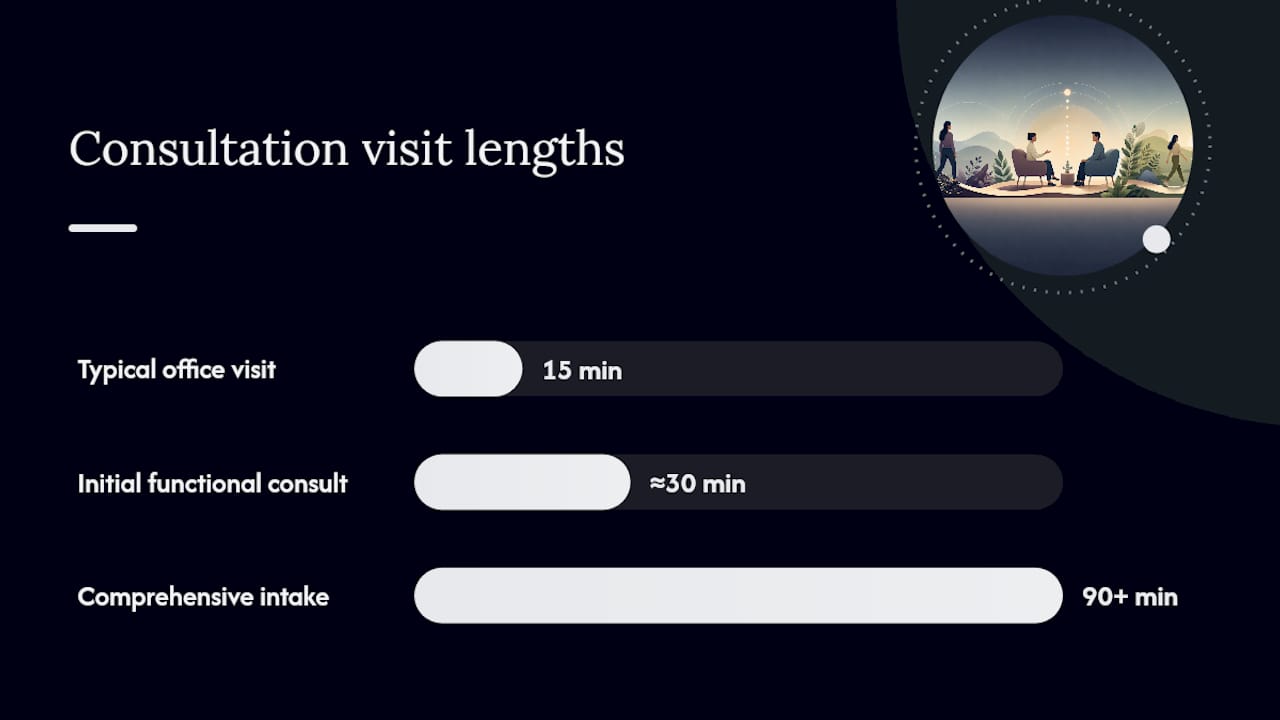
Expect a longer, more detailed process than a typical fifteen-minute office visit.
- An extensive intake, covering your full medical history, lifestyle, diet, stress, sleep, and environmental exposures.
- Targeted testing, layering standard labs with advanced testing only where the history actually points to it, not as a blanket order.
- Follow-up visits to review results and adjust the plan as your body responds.
Visit length varies by practice. Some initial consultations run about thirty minutes, while comprehensive intakes can stretch past ninety minutes. Care generally unfolds over months, not a single appointment.
Pro Tip: Ask about insurance coverage and out-of-pocket testing costs before the clinician orders anything. Advanced panels can run into the hundreds of dollars and aren't always covered, so get pricing upfront.
What Interventions Are Commonly Used in Functional Wellness?
The toolkit is broader than most people expect, but it follows a deliberate order.
- Food-first nutritional changes, usually the starting point for any plan.
- Sleep and stress-hygiene adjustments, since both drive hormonal and inflammatory patterns.
- Movement and exercise tailored to your current capacity.
- Targeted supplements or nutraceuticals, used selectively rather than as a default.
- Mind-body therapies, like breathwork or meditation, for nervous-system regulation.
- Medications or hormone therapy when a clinical picture genuinely calls for it.
Pro Tip: Cleveland Clinic's functional medicine team leans hard on a food-first strategy, and for good reason: many patients make real progress through diet and lifestyle alone before any testing or supplement gets added.
Supplements aren't risk-free. CBD, adaptogens, and herbal products can interact with prescription medications or shift how your liver metabolizes other drugs. If you're exploring CBD as part of a wellness routine, tell your treating clinician what you're taking before you add it, not after.

Does the Evidence Support Functional Wellness?
The rationale holds up better than the research volume does, at least so far.
- The systems-biology framework is grounded in real physiology, and lifestyle interventions like diet and sleep changes have strong independent evidence behind them.
- Large-scale randomized controlled trials specifically testing the full functional medicine model are still limited compared to conventional treatment research.
- Common criticisms include inconsistent practitioner training standards, variable quality of testing panels, high out-of-pocket costs, and a real risk of overusing supplements or unvalidated tests.
The sensible approach is co-management: use conventional care for acute, urgent, or emergency needs, and consider functional wellness for chronic, unresolved conditions where root-cause investigation adds real value.
How Do You Find a Qualified Functional Wellness Practitioner?
Not every provider labeled "functional" has equivalent training, so vetting matters.
Look for these signals:
- IFM-trained clinicians or equivalent formal certification
- A multidisciplinary team rather than a solo generalist
- Clear rationale for every test ordered, not blanket panels
- Willingness to coordinate with your primary care doctor
Before booking, ask:
- How long is the first visit, and what does it cover?
- What will testing cost, and is any of it covered by insurance?
- How often will we meet, and how do you track whether the plan is working?
Watch for red flags: guaranteed cures, identical protocols handed to every patient, and pressure to buy expensive supplement bundles upfront.
Where Can You Learn More About Functional Wellness?
For deeper reading, start with the IFM's overview, the PMC systems-biology review, and Cleveland Clinic's functional medicine program page. For clinical questions, prioritize peer-reviewed research and major academic medical centers over general wellness blogs.
Our Take on Functional Wellness
The strongest case for functional wellness isn't that it replaces conventional medicine. It's that conventional care is genuinely excellent at acute problems and often runs out of answers for chronic, vague, multi-system complaints. That's the gap this model was built to fill.
Where conventional advice falls short is in treating every unresolved symptom as a mystery to be managed rather than solved. Functional wellness's insistence on asking "why" is its real contribution, more than any specific supplement or test panel.
Where we'd push back on the hype: not every advanced test is worth its cost, and not every supplement stack is necessary. The food-first principle that Cleveland Clinic champions deserves more attention than it gets, because lifestyle change is unglamorous but it's where most people see the biggest early wins.
If you're considering this path, prioritize finding a well-trained clinician over chasing the newest testing panel. The relationship and the reasoning matter more than the lab work.
FAQ: Common Questions About Functional Wellness
Is functional wellness the same as functional medicine? Yes, the terms are typically used interchangeably to describe the same root-cause, systems-based approach to care.
Is functional medicine the same as integrative medicine? No. Functional medicine centers on finding root causes through systems-based analysis, while integrative medicine centers on combining conventional treatment with complementary therapies. The two frequently overlap in practice.
How long does it take to see results? Many people notice improvement within weeks of lifestyle changes, but complex or multi-system conditions can take three to six months or longer to fully resolve.
Does insurance cover functional wellness consultations? Coverage varies widely by provider and insurer. Ask about visit costs and testing fees before your first appointment, since advanced labs are sometimes billed out of pocket.
Can I combine functional wellness approaches with CBD or other supplements? Possibly, but always tell your clinician what you're taking. If you're curious how CBD fits into a broader wellness routine, start there, then loop in your provider before adding anything new, especially if you're on prescription medication.
Kingbuddha's sleep support gummies and CBD tinctures are lab-tested, U.S.-sourced options worth discussing with your functional wellness practitioner if sleep or stress management are part of your plan. Every product ships with third-party lab results, so you know exactly what you're adding to your routine before your next follow-up visit.
This article is general information, not a substitute for advice from a qualified doctor. Consult a qualified healthcare professional about your own circumstances before acting on anything here.
Sources
- Form Follows Function: A Functional Medicine Overview - PMC
- What is Functional Medicine? | IFM
- What is Functional Medicine? | Cleveland Clinic
- Functional vs. Integrative Medicine: How to Choose — Healthline
- Chronic Disease Overview — CDC