

What Is CBD Potency and How Does It Affect You
TL;DR:
- CBD potency indicates the concentration of cannabidiol in a product, usually measured in milligrams per milliliter or total milligrams.
- However, a higher potency does not automatically translate to stronger effects because factors like delivery method, metabolism, and product formulation influence actual experience.
You've seen CBD labels listing 500mg, 1500mg, or 3000mg and wondered what any of it actually means for your body. Understanding what is CBD potency is the single most useful skill you can develop as a CBD buyer, because the number on the bottle tells only part of the story. Potency affects how much you should take, which product type makes sense for your goals, and whether you're spending your money wisely. This guide breaks it all down without the jargon.
Table of Contents
- Key takeaways
- What CBD potency actually means
- How CBD potency is measured
- Why potency alone does not predict your experience
- Comparing CBD potency across products and spectrums
- My take: the potency number is a starting point, not a destination
- Find the right CBD potency for your goals at Kingbuddha
- FAQ
Key takeaways
| Point | Details |
|---|---|
| Potency measures concentration | CBD potency refers to how much CBD is packed into a product, expressed in mg/mL or as a percentage. |
| Potency does not equal effect | Your body's response depends on delivery method, metabolism, and product formulation, not just the number on the label. |
| HPLC testing sets the standard | Third-party lab testing using HPLC provides the most accurate potency data available to consumers. |
| Always check the COA | Verify batch-specific Certificates of Analysis to confirm the potency claim on any product you buy. |
| Full-spectrum products punch above their weight | Due to the entourage effect, full-spectrum products can deliver stronger results at lower potency than isolates. |
What CBD potency actually means
CBD potency explained simply: it is the concentration of cannabidiol present in a product, measured as milligrams per milliliter (mg/mL) or as a total milligram count in the package. That's it. Potency refers to concentration, while strength describes the overall therapeutic effect you actually feel.
This distinction matters more than most product pages let on. Two oils with identical potency can produce noticeably different effects depending on how they're formulated, what's in them alongside CBD, and how your body processes them. Treating potency as the final word on effectiveness leads to frustration and wasted money.
Here's how potency shows up on product labels across different formats:
- CBD oils and tinctures: Usually labeled with total milligrams per bottle (e.g., 1000mg per 30mL) and sometimes expressed as mg/mL.
- Gummies and edibles: Potency listed as milligrams per piece, such as 25mg per gummy, making dose tracking straightforward.
- Topicals: Expressed as total milligrams in the container, though absorption through skin differs significantly from other methods.
- Hemp flower: Potency displayed as percentage by weight of cannabinoid content, so a flower labeled 15% CBD contains about 150mg of CBD per gram.
Understanding these labeling conventions is the first step toward comparing products accurately. A 1000mg oil in a 10mL dropper bottle delivers 100mg/mL per dose. A 1000mg oil in a 30mL bottle gives you roughly 33mg/mL. Same milligram count, very different concentration per serving.
How CBD potency is measured
Labs use precise analytical methods to determine CBD content, and knowing which methods they use helps you trust or question the results. HPLC is the industry standard for cannabinoid potency testing because it measures compounds at room temperature, avoiding heat-related changes that can alter cannabinoid profiles and skew results.
Gas Chromatography, an older testing method, applies heat during analysis. Heat converts CBDA into CBD through decarboxylation, which can artificially inflate potency readings. HPLC sidesteps this problem entirely, giving you a cleaner picture of what's actually in the product before any processing occurs.
Pro Tip: When reviewing a Certificate of Analysis, check whether it was performed using HPLC. If the lab method isn't listed, ask the brand directly before purchasing.
The most important document in this process is the Certificate of Analysis (COA). Batch-specific COAs are what you want to see, not a generic lab result tied to a formula from six months ago. CBD potency can shift between production runs depending on raw material sourcing, extraction conditions, and formulation changes. Matching the batch number on the product label to the COA confirms the test is relevant to the specific bottle in your hand.
Here's what to look for when reading a COA:
- Potency panel: Lists CBD, CBDA, THC, and other cannabinoids present with their concentrations.
- Batch number: Cross-reference this with the number printed on your product.
- Testing date: Look for recent tests. Anything over a year old warrants scrutiny.
- Accreditation: The testing lab should carry ISO 17025 accreditation, which signals credible analytical standards.
| What to check | Why it matters | Red flag |
|---|---|---|
| Batch number match | Confirms test reflects your specific product | No batch number listed |
| HPLC testing method | Most accurate cannabinoid measurement | Method not disclosed |
| Full cannabinoid panel | Shows total CBD and THC content | Only CBD listed, nothing else |
| Lab accreditation | Ensures reliable, unbiased results | Unaccredited or in-house lab |
Brands that publish COAs openly and make batch numbers easy to verify are doing the bare minimum of what transparency requires. Treat missing or vague lab documentation as a reason to shop elsewhere.
Why potency alone does not predict your experience
Here is where most people get tripped up. A product with higher potency does not automatically produce stronger effects in your body. Actual therapeutic strength depends on bioavailability, metabolism, and formulation, not just the concentration number.
Bioavailability is the percentage of CBD that actually reaches your bloodstream. Sublingual tinctures deliver higher absorption than edibles because they bypass the digestive system and liver metabolism entirely. A 25mg sublingual dose can be more effective than a 50mg edible, depending on the individual.
Delivery method is only one variable. Here's the full picture of what shapes your actual response:
- Delivery method: Sublingual absorption outpaces oral ingestion. Topicals affect localized areas and largely stay out of the bloodstream.
- Individual metabolism: Your liver enzymes, body weight, and general metabolic rate all influence how CBD is processed. Two people taking the same dose from the same bottle can feel different results.
- Endocannabinoid system variability: Everyone's endocannabinoid system is calibrated differently. Someone with a more active system may need less CBD to notice an effect.
- Timing and food intake: Taking CBD with a fatty meal can increase absorption for oil-based products significantly.
Age also plays a meaningful role. Older adults metabolize cannabis more slowly, which increases sensitivity to potent products and raises the risk of side effects. If you're exploring CBD benefits later in life, you can read more about CBD effects for older adults to calibrate expectations appropriately.
Pro Tip: Start with the lowest effective dose for your product type, then increase gradually over one to two weeks based on how you feel. This method, sometimes called "start low, go slow," protects you from taking more than you need and helps you identify your personal sweet spot.
For personalized guidance, Kingbuddha's CBD dosage guide walks through this calibration process in detail based on goals and product type.
Comparing CBD potency across products and spectrums
Not all product categories carry the same potency ranges, and understanding CBD strength across formats helps you shop smarter. Below is a practical breakdown of typical ranges and what they mean.
| Product type | Typical CBD potency range | Best use case |
|---|---|---|
| Tinctures and oils | 250mg to 3000mg per 30mL | Fast absorption, flexible dosing |
| Gummies and edibles | 5mg to 50mg per piece | Precise, consistent dosing |
| Topicals | 200mg to 1500mg per container | Localized discomfort, skin support |
| Hemp flower | 8% to 20% CBD by weight | Those preferring inhalation delivery |
| Soft gels and capsules | 10mg to 50mg per capsule | Discreet use with consistent absorption |
Beyond the format, the spectrum type has a major impact on how potency translates into experience. Full-spectrum products contain CBD alongside minor cannabinoids, terpenes, and trace THC (under 0.3%). Full-spectrum CBD may work more effectively at lower doses than isolate products because of the entourage effect, where cannabinoids and terpenes amplify each other's activity.
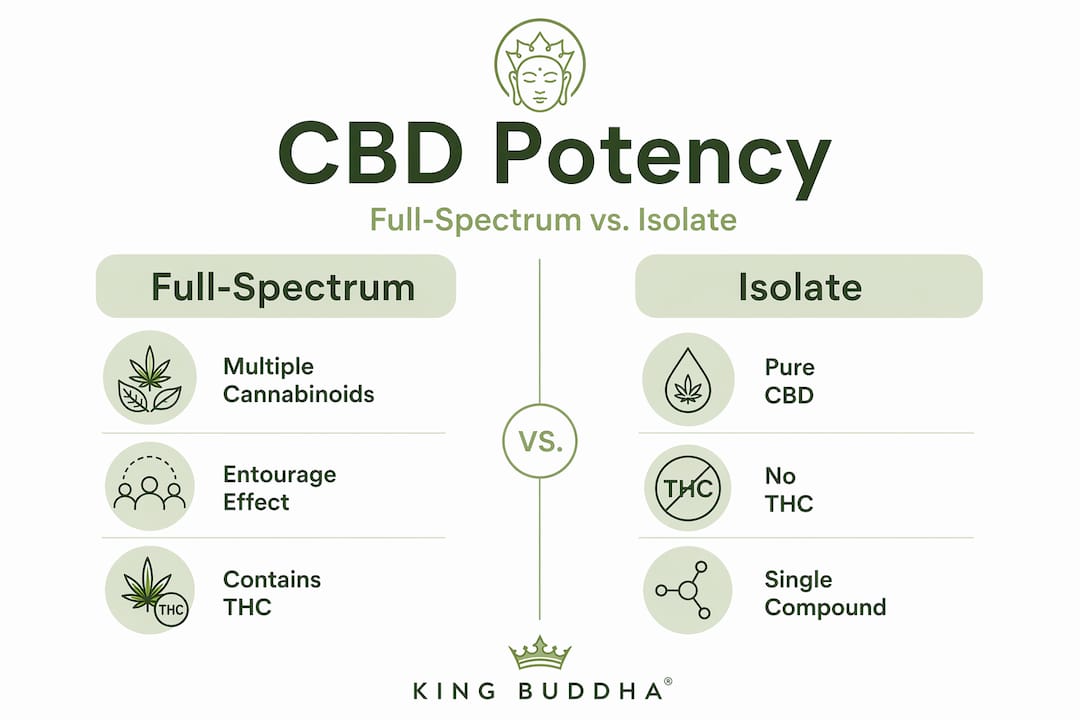
Broad-spectrum products remove THC while keeping other cannabinoids and terpenes, offering a middle path for people who want some entourage effect without any THC exposure. CBD isolate is pure cannabidiol, so the label potency is a direct reflection of what you're getting with no amplifying compounds in the mix.
This is why comparing CBD potency numbers between a full-spectrum tincture and a CBD isolate product can be misleading. The full-spectrum product may deliver more noticeable effects at 25mg than an isolate product at 35mg. For a deeper look at how these formats differ, the full spectrum vs broad spectrum breakdown from Kingbuddha covers the practical differences clearly.
My take: the potency number is a starting point, not a destination
I've seen more confusion around CBD potency numbers than almost any other topic in this space. People buy the highest milligram option thinking they're getting the most powerful product, then feel nothing, then conclude that CBD doesn't work for them. That story plays out constantly.
What I've learned is that potency is only the first filter. It tells you what's in the bottle. It does not tell you what will happen in your body. A well-formulated 750mg full-spectrum tincture with quality terpenes and transparent lab testing will outperform a poorly extracted 2000mg isolate product nine times out of ten.
The brands worth trusting are the ones who make it easy to verify their claims. Batch-specific COAs, clearly disclosed extraction methods, and straightforward labeling are signs that a company understands their product deeply enough to stand behind it. Vague potency claims or missing lab data should disqualify a product from your consideration immediately.
My practical advice: pick a delivery method that fits your lifestyle, choose a spectrum type based on your goals, confirm the COA, and start conservatively. Adjust from there. The number on the label matters far less than the quality of what went into making it.
— Juiced
Find the right CBD potency for your goals at Kingbuddha
Knowing what CBD potency means is powerful. Putting that knowledge to work with products you can actually trust is the next move. Kingbuddha offers a curated lineup of lab-tested CBD products with full transparency on potency, spectrum type, and batch-specific COA data. Whether you want the precise dosing of CBD sleep gummies, the flexible absorption of full-spectrum tinctures, or the raw potency of hemp flower with verified CBD percentages, every product comes backed by third-party testing and U.S.-sourced ingredients. Stop guessing at dosage and start shopping with the clarity you now have.
FAQ
What does CBD potency mean?
CBD potency refers to the concentration of cannabidiol in a product, expressed as milligrams per milliliter, total milligrams per package, or as a percentage by weight. It measures how much CBD is present, not how strong the effect will be in your body.
Is higher CBD potency always better?
Not necessarily. Higher potency means more CBD per serving, but actual effectiveness depends on delivery method, your metabolism, and product formulation. Full-spectrum products can produce stronger results at lower potency due to the entourage effect.
How is CBD potency tested?
CBD potency is measured using High-Performance Liquid Chromatography (HPLC), which analyzes cannabinoid concentrations without applying heat. Results are documented in a Certificate of Analysis, and batch-specific COAs are the most reliable way to verify what's in your product.
What CBD potency should a beginner start with?
Beginners typically do well starting with 10mg to 25mg per serving, then adjusting gradually based on personal response. A sublingual tincture allows for flexible dosing, making it easier to find your effective amount without overshooting.
Does the delivery method change how potency affects you?
Yes. Sublingual tinctures have higher bioavailability than edibles because they bypass digestion, meaning a lower potency tincture dose can outperform a higher potency edible dose in terms of how much CBD your bloodstream actually receives.