

Terpenes in CBD: 5 Key Benefits for Wellness 2026
TL;DR:
- Terpenes are natural compounds in hemp that enhance CBD's therapeutic effects through the entourage effect.
- Full-spectrum CBD products typically have higher terpene levels than broad-spectrum or isolates.
- Verifying terpene content requires checking third-party lab reports for accurate and transparent information.
If you've been shopping for CBD products by milligram count alone, you're missing half the picture. Terpenes, the naturally occurring aromatic compounds in hemp and other plants, are quietly shaping how effective your CBD experience actually is. Most users scroll past terpene information entirely, not realizing these compounds may be the difference between a product that genuinely supports your wellness and one that just smells nice. This guide breaks down what terpenes are, what the science says about their benefits, how product types differ in terpene content, and exactly how to shop smarter for CBD products that deliver real results.
Table of Contents
- What are terpenes and why do they matter in CBD products?
- Exploring the therapeutic benefits: Anxiety, sleep, pain, and beyond
- Full-spectrum vs broad-spectrum CBD: How terpene content varies
- How to choose high-quality CBD products with terpenes
- Why terpenes are the wellness gamechanger most CBD users ignore
- Discover premium CBD with terpenes for your wellness goals
- Frequently asked questions
Key Takeaways
| Point | Details |
|---|---|
| Terpenes enhance CBD effects | Specific terpenes can boost CBD’s benefits for sleep, stress, and wellness. |
| Product types matter | Full-spectrum CBD typically retains more terpenes than broad-spectrum versions. |
| Always check COAs | Trust only products with third-party lab reports listing both cannabinoids and terpenes. |
| Transparency protects quality | Clear labeling and lab reports help ensure you get real therapeutic ingredients. |
What are terpenes and why do they matter in CBD products?
Now that you know there's more to CBD than meets the eye, let's break down what terpenes are and why they play a starring role in your wellness experience.
Terpenes are natural chemical compounds produced by plants, primarily to attract pollinators and repel predators. They're responsible for the sharp citrus scent of lemon peel, the calming fragrance of lavender, and the earthy musk of pine forests. In hemp plants, terpenes are produced in the same resin glands as cannabinoids like CBD and THC, which means they naturally end up in many of the CBD products you already use.
Some of the most common terpenes you'll find in CBD products include:
- Limonene: Citrusy, uplifting, often associated with mood support
- Myrcene: Earthy and herbal, commonly linked to relaxing effects
- Linalool: The same compound in lavender, studied for calming and sleep support
- Pinene: Fresh pine scent, associated with mental clarity and alertness
- Caryophyllene: Spicy and peppery, notable as the only terpene that also acts on cannabinoid receptors directly
These aren't just about flavor and scent. They interact with your body's endocannabinoid system and other receptor pathways alongside CBD, potentially amplifying or modifying the overall effect. This interaction is called the entourage effect, the theory that the full range of plant compounds works better together than any single compound alone. Research into CBD terpene profiles has grown significantly as more consumers and researchers recognize this synergy.
"The entourage effect suggests that terpenes, cannabinoids, and other plant compounds team up to produce effects that isolated CBD simply cannot replicate on its own."
Studies support this view. A full-spectrum CBD product was found to reduce anxiety symptoms and improve mood and sleep, with terpenes cited as potential contributors alongside CBD. This is a meaningful signal for health-conscious consumers who want more than a surface-level supplement.
Pro Tip: When reading product descriptions, look for the specific terpene names listed, not just the words "natural terpenes." Vague labeling is a red flag for poor quality control.
Exploring the therapeutic benefits: Anxiety, sleep, pain, and beyond
With an understanding of what terpenes are, we can now look into how they actually work in your body and mind, especially in combination with CBD.
The clinical research is still growing, but the results so far are genuinely promising. A double-blind, placebo-controlled study found that a CBD-terpene formulation increased slow-wave sleep and REM sleep by 1.3%, two of the most restorative sleep stages, in people with insomnia. That's not a trivial improvement for someone dealing with restless nights.
For anxiety and stress, the empirical support is strongest when limonene and linalool are combined with CBD. These terpenes appear to interact with serotonin and GABA receptors, pathways that regulate mood and stress response. Linalool specifically has been studied in preclinical models for its calming properties, and its presence in lavender-based aromatherapy has a long track record of use.
Here's a quick breakdown of which terpenes show the most promise for specific wellness goals:
| Terpene | Primary effect | Best paired with |
|---|---|---|
| Limonene | Mood uplift, anxiety relief | CBD tinctures |
| Linalool | Calm, sleep support | Full-spectrum CBD |
| Myrcene | Relaxation, muscle ease | Broad-spectrum gummies |
| Caryophyllene | Anti-inflammatory (preclinical) | CBD topicals |
| Pinene | Alertness, focus | Morning CBD formulas |
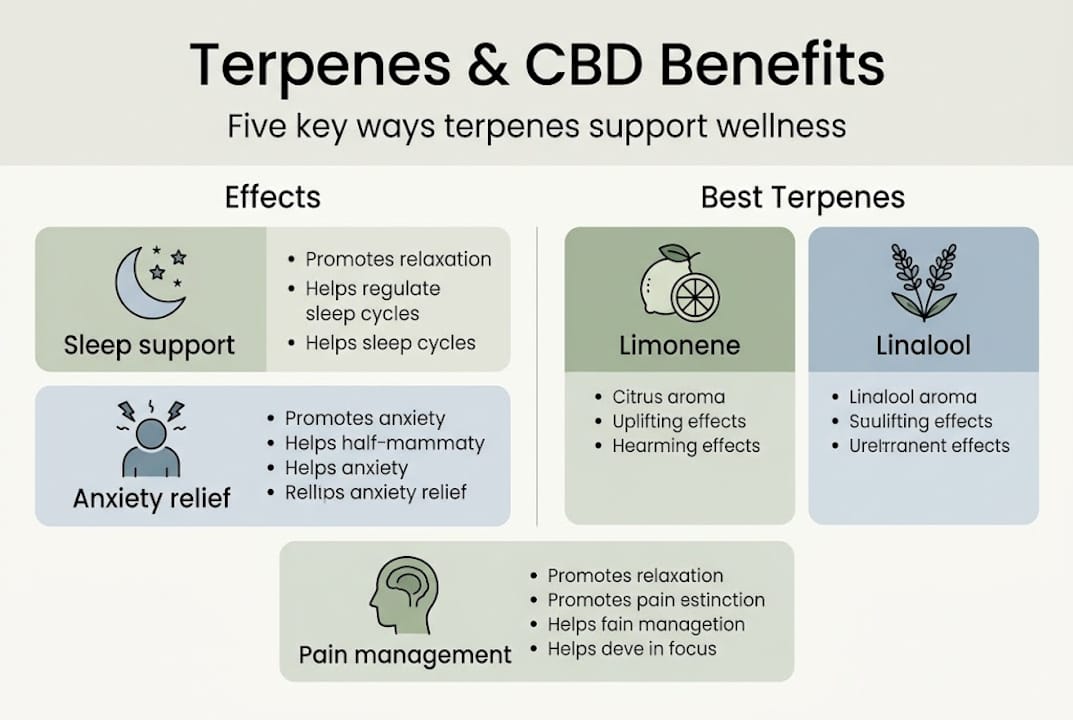
For pain and inflammation, most of the evidence remains preclinical, meaning it comes from animal or cell-based studies rather than large human trials. Caryophyllene in particular has drawn interest because it binds directly to CB2 receptors, which are involved in immune function and inflammation. More human research is needed, but it's a compelling area to watch.
Exploring terpene tinctures or a dedicated CBD plus terpenes formula gives you access to these targeted profiles rather than relying on a generic product.
Key takeaway: If you're using CBD mainly for sleep or stress, the terpene profile in your product is arguably as important as the CBD milligram count.
Full-spectrum vs broad-spectrum CBD: How terpene content varies
Knowing what terpenes can do makes it even more important to understand how they show up in the CBD products you buy.
Not all CBD products contain the same terpene levels, and product type plays a big role in this. Here's how the main categories differ:
| Feature | Full-spectrum CBD | Broad-spectrum CBD |
|---|---|---|
| THC content | Up to 0.3% (legal limit) | None or non-detectable |
| Terpene content | High, naturally preserved | Moderate, some lost in processing |
| Entourage effect potential | Strongest | Moderate |
| Best for | Maximum therapeutic synergy | THC-sensitive users |
Full-spectrum CBD is extracted from the hemp plant in a way that preserves a wide range of cannabinoids, terpenes, and flavonoids. Broad-spectrum CBD goes through additional processing to remove THC, and that process can strip some terpenes in the bargain. Isolate products contain only CBD with no terpenes at all.
This matters because CBD products labeled full or broad-spectrum may contain terpenes, but the only way to know what's actually in a product is to check the Certificate of Analysis (COA) from a third-party lab. Learning more about full-spectrum vs broad-spectrum CBD helps you make a truly informed choice.
Here's a simple step-by-step for checking terpene content before you buy:
- Locate the QR code or COA link on the product page or packaging.
- Open the lab report and find the terpene panel (it should list individual terpenes and their concentrations).
- Check that the lab used is a licensed, accredited third party, not the brand's own facility.
- Match the batch number on the COA to the batch number on your product.
- Look for terpene concentrations reported in percentages or mg/g, not just a checkbox saying "terpenes present."
Understanding what full spectrum CBD is before shopping gives you a real advantage in a market that's still full of vague labeling and overstated claims.
How to choose high-quality CBD products with terpenes
Once you know what you're looking for, the next step is making sure you actually get what you pay for. This is where quality and transparency matter.
The CBD market is large and largely unregulated at the federal level. There is no FDA-approved standard for terpene labeling in non-prescription CBD products, and requirements vary by state. That means brands have wide discretion in how they describe terpene content, which opens the door for misleading claims.
Here are the biggest red flags to watch for when shopping:
- Labels that say "contains terpenes" without naming which ones
- No third-party COA available or accessible
- COA that tests only cannabinoids without a terpene panel
- Terpene claims that seem unusually high with no lab data to back them up
- Products with "proprietary blends" used as an excuse to hide exact formulations
A trustworthy brand will always publish a batch-specific COA that includes a detailed terpene breakdown. This isn't just good practice, it's the minimum you should expect when you're making a wellness purchase. Our guide on CBD tinctures primer walks through exactly what to look for in product documentation.
"Transparency isn't a marketing buzzword. It's the only way consumers can verify that a product contains what the label claims."
Pro Tip: Always download the COA directly from the lab's website using the report number, not just from the brand's website. This confirms the document hasn't been altered.
When you find a product that passes these checks, you know you're getting something real. Quality terpene content is not cheap to produce or preserve, so price can be a signal too. A strikingly low-cost full-spectrum product should prompt more questions, not fewer.
Why terpenes are the wellness gamechanger most CBD users ignore
To wrap up, it's worth asking: why don't more people talk about terpenes, and what are savvy consumers doing differently?
Most people walk into the CBD conversation focused on one number: milligrams of CBD. It's an easy shortcut, but it's also incomplete. Terpenes are the part of the formula that can shift a product from generic to genuinely targeted. A 1000mg CBD tincture without a meaningful terpene profile may actually underperform compared to a well-formulated 500mg product rich in relevant terpenes.
The consumers seeing the best results from CBD are the ones asking harder questions. They want to know the specific terpene concentrations, not just "full-spectrum" on a label. They understand that how we select terpenes for a product reflects the brand's commitment to real therapeutic value, not just marketing language. They read COAs the way others read nutrition labels.
The industry is slowly catching up to this demand. More brands are publishing terpene-specific data, and formulations are becoming increasingly targeted. But the gap between what informed consumers know and what average buyers expect is still wide. Closing that gap starts with understanding that terpenes aren't a bonus feature. They're a core component of an effective CBD experience.
Discover premium CBD with terpenes for your wellness goals
If you're ready to experience the benefits of expertly formulated CBD with terpenes, start with these trusted options.
At King Buddha, every product is built around transparency and therapeutic intent. Our our CBD tinctures are crafted with published COAs that include full terpene breakdowns, so you always know what you're putting in your body. For a more targeted approach, our terpene tinctures let you choose formulas designed around specific terpene profiles for stress, focus, or relaxation.
If sleep support is your priority, our CBD sleep gummies combine CBD with sleep-supportive terpenes like linalool and myrcene for a targeted nighttime routine. Everything is third-party tested, U.S.-sourced, and formulated with your actual wellness goals in mind.
Frequently asked questions
What are the most common terpenes found in CBD products?
The most common terpenes include limonene, myrcene, linalool, pinene, and caryophyllene, each contributing unique aromas and effects. These compounds have been studied for their therapeutic contributions alongside CBD in wellness applications.
Do terpenes make CBD more effective for sleep?
Certain terpenes like linalool and myrcene, combined with CBD, may enhance sleep quality, as supported by emerging clinical research. A clinical trial found that a CBD-terpene blend increased restorative sleep stages by 1.3% in insomnia patients.
How can I verify the presence of terpenes in a CBD product?
Check for a third-party Certificate of Analysis showing the specific terpene breakdown and compare it with the label. Knowing how to read a CBD label helps you confirm that terpene content is real and accurately reported.
Are terpenes regulated in CBD products?
There is no federal terpene labeling standard, and some states have stricter requirements than others, so always review COAs for accurate information. Relying only on a product label without checking how to read a CBD label leaves you vulnerable to inaccurate terpene claims.