

How Does CBD Work in the Body: A Clear Guide
TL;DR:
- CBD interacts indirectly with the endocannabinoid system, serotonin receptors, ion channels, and liver enzymes, influencing pain, mood, and inflammation. Its low oral bioavailability and individual metabolism cause wide variability in effects, emphasizing consistent dosing and taking it with high-fat food for better absorption. CBD provides broad physiological benefits without causing intoxication, making it a versatile wellness tool.
CBD is a non-intoxicating compound derived from hemp that works in the body by engaging multiple receptors, enzymes, and signaling pathways to influence pain, mood, inflammation, and overall physiological balance. Understanding how CBD works in the body goes far beyond a single receptor story. The mechanism, formally called CBD's pharmacological action, spans the endocannabinoid system, serotonin receptors, ion channels, and liver enzymes. Kingbuddha's products are built around this science, and knowing the biology helps you make smarter choices about formulation, dosing, and timing.
How does CBD work in the body through the endocannabinoid system?
The endocannabinoid system (ECS) is the primary biological network CBD interacts with, and it regulates pain, mood, immune response, and sleep across nearly every organ system. The ECS operates through two main receptor types: CB1 receptors, concentrated in the brain and central nervous system, and CB2 receptors, found predominantly in immune tissues and peripheral organs.

Here is where CBD diverges sharply from THC. THC binds directly and powerfully to CB1 receptors, producing intoxication. CBD has low direct affinity for both CB1 and CB2 receptors. Instead, it acts as a modulator, adjusting how those receptors respond to the body's own endocannabinoids rather than flooding them with a signal. This distinction is why CBD produces no high.
CB1 and CB2 receptors are G-protein coupled receptors. When activated, they inhibit adenylyl cyclase, lower cyclic AMP levels, and modulate calcium and potassium channels. The downstream result is a change in how neurotransmitters like serotonin and dopamine are released. CBD's modulatory role within this system means it nudges these pathways rather than overriding them.
The practical implication is significant. Because CBD does not directly activate CB1 receptors the way THC does, it can influence pain and mood without producing dependency-linked euphoria. This makes it a genuinely different tool from cannabis intoxicants, not just a weaker version of the same thing.
- CB1 receptors are concentrated in the brain, spinal cord, and peripheral nervous system, making them central to pain and mood regulation.
- CB2 receptors are primarily found in immune cells, the spleen, and the gut, where they modulate inflammation and immune signaling.
- CBD's modulatory role means it adjusts receptor sensitivity rather than directly activating or blocking receptors.
- THC comparison: THC directly agonizes CB1 receptors; CBD does not, which explains the absence of psychoactive effects.
Pro Tip: If you are new to CBD, understanding that it works indirectly on the ECS helps explain why effects can feel subtle at first. Consistent use over days or weeks often produces more noticeable results than a single dose.
What other molecular targets does CBD interact with?
CBD's multi-target pharmacology is the real reason it produces such a wide range of reported effects. Limiting the explanation to cannabinoid receptors misses most of the story.
-
FAAH enzyme inhibition. CBD inhibits fatty acid amide hydrolase (FAAH), the enzyme responsible for breaking down anandamide, often called the body's natural "bliss molecule." By slowing FAAH activity, CBD raises anandamide levels in the brain and body. Higher anandamide is associated with reduced anxiety, improved mood, and pain modulation. This is one of CBD's most clinically significant mechanisms.
-
Serotonin 5-HT1A receptor activation. CBD directly activates the 5-HT1A serotonin receptor, the same receptor targeted by buspirone, a common anti-anxiety medication. This interaction contributes to CBD's reported effects on stress and anxiety. The 5-HT1A pathway also plays a role in nausea suppression and neuroprotection.
-
TRPV1 ion channel activation. The transient receptor potential vanilloid 1 (TRPV1) channel is involved in pain signaling and body temperature regulation. CBD activates TRPV1, which initially increases pain sensitivity but then desensitizes the channel with repeated activation. This desensitization effect is thought to contribute to CBD's analgesic properties over time.
-
GPR55 receptor antagonism. GPR55 is sometimes called the "third cannabinoid receptor." CBD blocks GPR55 activity. GPR55 activation is linked to increased bone density loss, cancer cell proliferation, and inflammatory signaling. Blocking it may contribute to CBD's anti-inflammatory and potentially anti-proliferative properties, though research here is still developing.
-
Adenosine reuptake inhibition. CBD slows the reuptake of adenosine, a neuromodulator that promotes sleep and reduces inflammation. Higher adenosine levels in the brain contribute to the calming and anti-inflammatory effects many users associate with CBD.
Together, these five pathways explain why CBD influences such a broad spectrum of physiological functions. No single receptor accounts for the full picture.
How does the body absorb, metabolize, and distribute CBD?
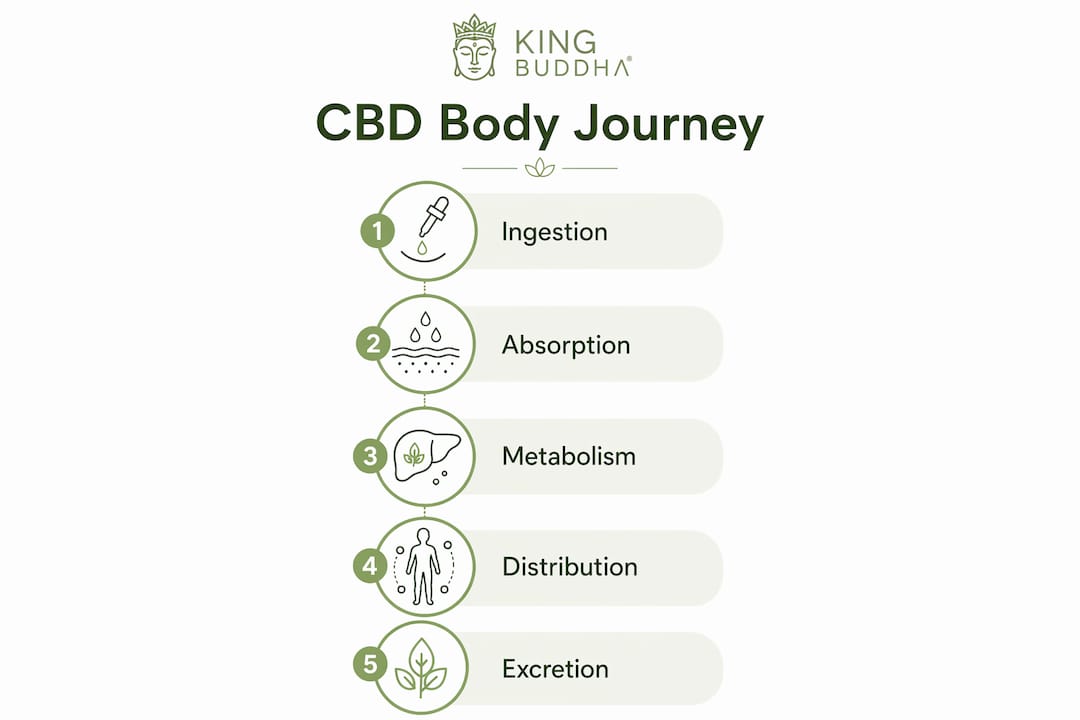
Pharmacokinetics, the science of how the body processes a substance, dictates how much CBD actually reaches your bloodstream and tissues. The gap between the dose you take and the dose your body uses is larger with CBD than most people realize.
Oral CBD bioavailability sits at roughly 6 to 14%, meaning the majority of a standard oral dose is lost before it reaches systemic circulation. This happens because CBD is fat-soluble and poorly absorbed through the gut lining, and because the liver intercepts and metabolizes a large portion before it enters the bloodstream. This is called first-pass metabolism.
The liver enzymes CYP3A4 and CYP2C19 are the primary metabolizers of CBD. They convert it into two key metabolites: 7-OH-CBD, which is pharmacologically active and contributes to CBD's effects, and 7-COOH-CBD, which is inactive and excreted. The activity level of these enzymes varies between individuals based on genetics, age, and other medications, which is a major reason why two people taking the same dose can have very different experiences.
| Pharmacokinetic factor | What it means for you |
|---|---|
| Oral bioavailability (6–14%) | Most of an oral dose is lost before reaching the bloodstream |
| First-pass metabolism | Liver enzymes reduce CBD levels before systemic absorption |
| Active metabolite (7–OH-CBD) | Contributes to pharmacological effects alongside CBD itself |
| Food effect (up to 5x increase) | High-fat meals dramatically increase CBD absorption |
| Half-life (2–5 hours) | CBD clears relatively quickly, affecting dosing frequency |
High-fat meals can increase CBD plasma exposure by up to fivefold compared to fasting. This is one of the most underappreciated facts in CBD use. Taking your CBD tincture or capsule with avocado, eggs, or full-fat yogurt is not a minor detail. It can be the difference between a therapeutic dose and a subtherapeutic one.
Once absorbed, CBD distributes widely into tissues, including the central nervous system, adipose tissue, and organs. You can explore how this affects duration of effects in Kingbuddha's guide on CBD elimination timelines.
Pro Tip: Take CBD with a meal containing healthy fats. This single habit can multiply the amount of CBD your body actually absorbs, making your product more effective without changing the dose.
What physiological effects does CBD produce and how do they support wellness?
CBD's molecular interactions translate into measurable physiological effects across several body systems. Understanding these connections helps set realistic expectations.
CBD modulates neurotransmitters including GABA, glutamate, dopamine, and serotonin, which are the chemical messengers governing stress response, mood stability, and cognitive function. Increased GABA activity produces calming effects. Serotonin modulation supports mood regulation. This is why CBD's effects on anxiety are not placebo-driven speculation. They reflect real neurochemical changes.
- Pain relief: CBD acts on TRPV1 channels, CB2 receptors in peripheral tissues, and anandamide levels to reduce both inflammatory and neuropathic pain signals.
- Stress and anxiety reduction: Activation of 5-HT1A receptors and increased anandamide both contribute to reduced anxiety responses, with effects comparable in mechanism to some pharmaceutical anxiolytics.
- Anti-inflammatory action: CBD suppresses pro-inflammatory cytokine production through CB2 receptor modulation and GPR55 antagonism, making it relevant for conditions driven by chronic inflammation.
- Sleep support: Adenosine reuptake inhibition and reduced anxiety together promote the physiological conditions for deeper, more restorative sleep.
- Neuroprotection: CBD's antioxidant properties and modulation of glutamate excitotoxicity may protect neurons from damage, a mechanism being studied in conditions like epilepsy and neurodegenerative disease.
CBD does not produce intoxication because it avoids direct CB1 agonism. This means you get the physiological benefits of endocannabinoid system modulation without impaired cognition or coordination. For daily wellness use, that distinction matters enormously.
Why do people experience different effects from CBD?
Two people can take identical CBD products at identical doses and report completely different outcomes. This is not anecdote. It reflects real pharmacokinetic and genetic variability.
Individual variability in CBD blood levels is well-documented and substantial. The primary drivers include genetic differences in CYP2C19 enzyme activity, body composition, gut microbiome health, and concurrent medication use. People classified as "poor metabolizers" of CYP2C19 retain higher CBD levels for longer. "Rapid metabolizers" clear it faster and may need higher or more frequent doses to achieve the same effect.
CBD interactions with medications are a real clinical concern. Because CYP3A4 and CYP2C19 metabolize many common drugs, CBD can raise or lower the blood levels of those medications. Blood thinners, antiepileptics, and certain antidepressants are among the most commonly affected. If you take any prescription medication, discussing CBD with your physician is not optional caution. It is necessary.
Formulation also plays a significant role. CBD in oil-based tinctures absorbs differently than CBD in powder capsules or water-soluble emulsions. Kingbuddha's guide on CBD absorption modes breaks down how each delivery method affects how much CBD reaches your system.
- Genetics: CYP enzyme variants determine how fast you metabolize CBD, affecting both duration and intensity of effects.
- Food intake: Fasting dramatically reduces absorption; high-fat meals can multiply it.
- Formulation type: Oil, powder, and emulsified forms each have different bioavailability profiles.
- Body composition: CBD accumulates in fat tissue, which can affect how long it remains active.
Pro Tip: Keep a simple log of your CBD dose, timing, food intake, and effects for two weeks. This data will tell you more about your personal response than any general dosing chart.
Key takeaways
CBD works through a multi-target mechanism spanning the endocannabinoid system, serotonin receptors, ion channels, and liver enzymes, with bioavailability and individual metabolism determining how much of that mechanism actually reaches your body.
| Point | Details |
|---|---|
| Multi-target mechanism | CBD acts on CB receptors, FAAH, 5-HT1A, TRPV1, and GPR55 simultaneously. |
| No intoxication | CBD avoids direct CB1 agonism, producing no psychoactive effects unlike THC. |
| Low oral bioavailability | Only 6–14% of an oral dose reaches circulation; take with high-fat food to improve this. |
| Individual variability | Genetics, metabolism, and medications cause wide differences in CBD response between users. |
| Consistent dosing matters | CBD’s 2–5 hour half-life and variable absorption mean regular, timed dosing produces better results. |
What years of watching people use CBD has taught me
Most people approach CBD expecting it to work like ibuprofen: take it, feel it within an hour, done. That expectation sets them up for disappointment. CBD is a modulator, not a switch. It adjusts systems that are already running, which means the effects are often subtle, cumulative, and context-dependent.
The most common mistake I see is under-dosing combined with inconsistent timing. Someone takes a small dose on an empty stomach, feels nothing, and concludes CBD does not work for them. What actually happened is that their bioavailability was near zero and their dose never reached a therapeutic threshold. The pharmacokinetic limitations of oral CBD are not a flaw in the product. They are a biological reality that requires a smarter approach to dosing.
The multi-target nature of CBD is also underappreciated. People ask which receptor CBD works on, as if there is one answer. There are at least five significant molecular targets, and the relative contribution of each varies by dose, formulation, and individual biochemistry. This complexity is actually good news. It means CBD has genuine physiological reach across pain, mood, inflammation, and sleep, not just one narrow effect.
My honest advice: start with a quality oil-based tincture, take it with food, give it three to four weeks of consistent daily use before evaluating, and check Kingbuddha's CBD dosage guide to calibrate your starting point. If you take prescription medications, talk to your doctor first. That is not overcaution. It is how you protect the results you are working toward.
— Juiced
Explore Kingbuddha's CBD products built for real results
Understanding the science behind CBD is the first step. Choosing the right formulation is the second. Kingbuddha offers CBD tinctures in broad and full spectrum options, formulated for maximum absorption and consistent dosing. For sleep support specifically, the CBD Sleep Support Gummies combine precise CBD dosing with sleep-targeted ingredients in a format that is easy to work into a nightly routine. Every product is third-party lab tested, made with U.S.-sourced hemp, and compliant with the 2018 Farm Bill. If you want to put the mechanisms described in this article to work, Kingbuddha's product line gives you the formulations to do it right.
FAQ
How does CBD interact with receptors in the body?
CBD primarily modulates CB1 and CB2 cannabinoid receptors indirectly, while also directly activating serotonin 5-HT1A receptors and TRPV1 ion channels. This multi-receptor engagement explains its broad effects on pain, mood, and inflammation.
Can CBD affect anxiety without causing a high?
Yes. CBD activates 5-HT1A serotonin receptors and raises anandamide levels by inhibiting FAAH, both of which reduce anxiety responses without engaging the CB1 receptor pathway that produces THC's intoxicating effects.
Why does CBD work differently for different people?
Genetic differences in CYP2C19 and CYP3A4 enzyme activity, body composition, food intake, and concurrent medications all affect how much CBD reaches the bloodstream and how long it stays active, producing wide variability in individual responses.
What is the best way to take CBD for maximum absorption?
Taking CBD with a high-fat meal is the most evidence-backed method for improving absorption. Research shows food intake can increase CBD plasma exposure by up to fivefold compared to taking it on an empty stomach.
Does CBD stay in your system long enough for daily dosing to matter?
CBD has a half-life of roughly 2 to 5 hours, meaning it clears relatively quickly. Daily consistent dosing builds more stable tissue levels over time, which is why regular users typically report better results than occasional users.